
A small shop needs four things to stay on top of its accounts: a daily cash and UPI record, a purchase and sales file, a monthly bank match, and a yearly return that fits its turnover. That’s the core of accounting for small business owners in India. A kirana, a tailoring unit or a mobile repair counter doesn’t need a full corporate ledger on day one. It needs the minimum set that keeps the tax office, the bank and your own margins clear.
Ask most shop owners how they keep accounts and you’ll hear “diary mein likhte hain”. That’s not wrong. It’s just incomplete.
The government’s own survey counted 7.34 crore unincorporated non-farm establishments in 2023-24, up from 6.50 crore a year earlier, and most of them are tiny shops and service counters run by the owner. So what this means is that the bulk of Indian business still runs on informal books, and the gap between “we write it down” and “we can prove it” is where trouble starts.
What does “accounting” even mean for a small shop?
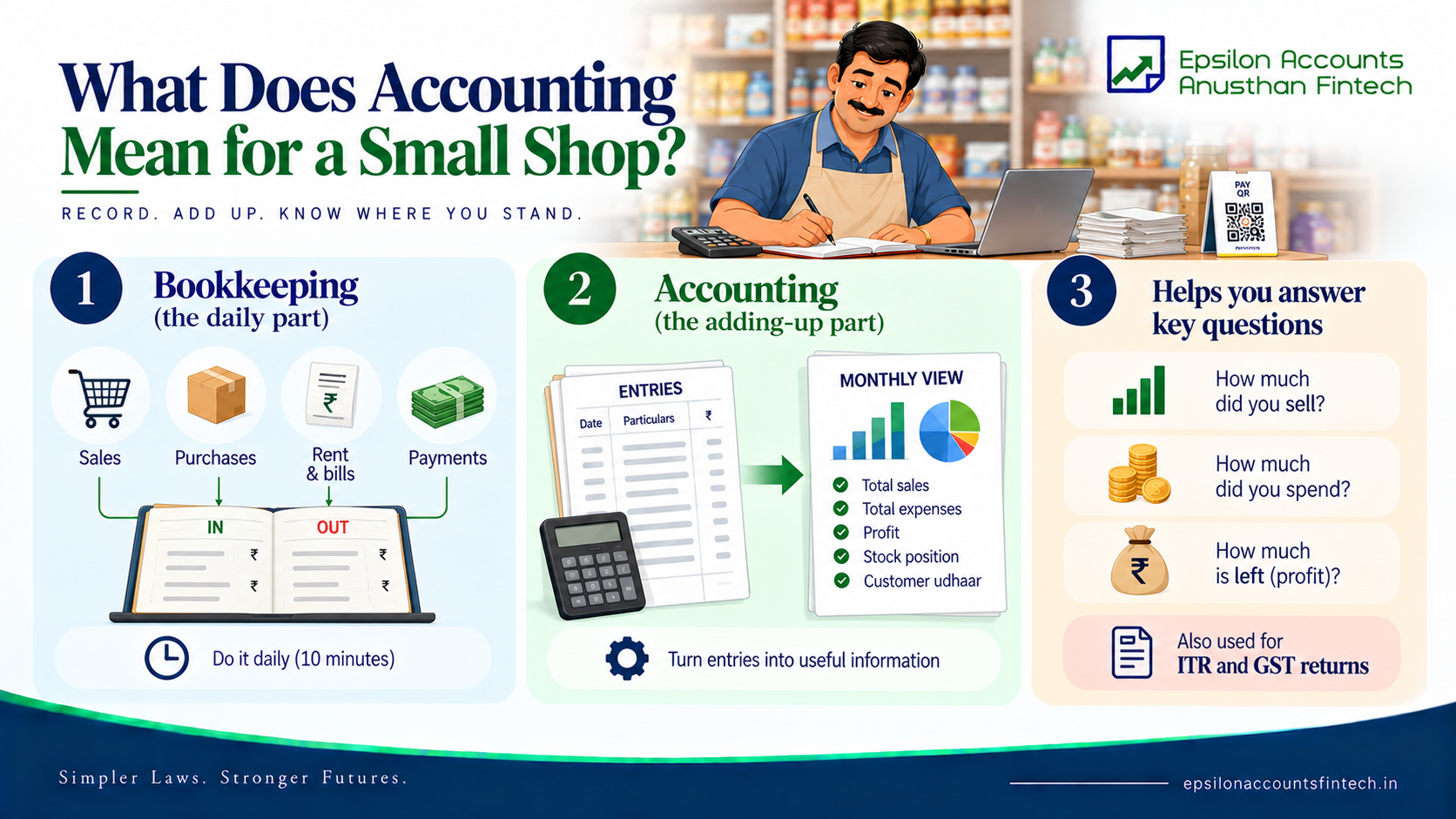
For a small shop, accounting simply means recording every rupee that comes in and goes out, keeping the bill behind it, and adding it all up at month end and year end. It’s about answering three questions: how much did you sell, how much did you spend, and how much is left.
Bookkeeping is the daily part
Bookkeeping is the writing-down bit. Every sale, wholesaler bill and rent payment gets an entry. If you do this daily, it takes ten minutes. If you leave it for a month, it takes a whole Sunday and you’ll still miss things.
Accounting is the adding-up part
Accounting takes those entries and turns them into something useful: your profit for the month, how much stock you’re sitting on, and how much udhaar (credit) your customers owe you. It’s also what feeds your income tax return, and your GST returns if you’re registered.
Which records should every small shop keep from day one?
Every small shop should keep five records from the very first day: a cash book, a UPI and bank record, purchase bills, sales bills or a sales register, and a credit (udhaar) register. These five cover nearly everything a CA, a bank or a tax officer will ever ask you for.
| Record | What goes in it | How often to update |
| Cash book | Cash received and cash paid out | Daily, at closing |
| UPI and bank record | QR payments, card swipes, bank transfers | Weekly match with statement |
| Purchase file | Wholesaler bills, supplier invoices | Every time stock comes in |
| Sales register | Bills issued, or total daily sales if you don’t bill | Daily |
| Udhaar register | Who owes you, how much, since when | Every credit sale and every repayment |
The cash book matters most
It’s the one record that shows whether money is leaking. If your cash in hand at night doesn’t match what the cash book says, something is off, whether that’s a missed entry, a family member dipping into the gala, or a staff problem.
Keep personal and shop money apart
The thing to note here is that most small shop owners pay school fees, groceries and EMIs from the same UPI account that collects shop payments. That one habit makes it almost impossible to work out real profit. A separate current account, even a basic one, fixes this.
How does your turnover decide what you need to file?
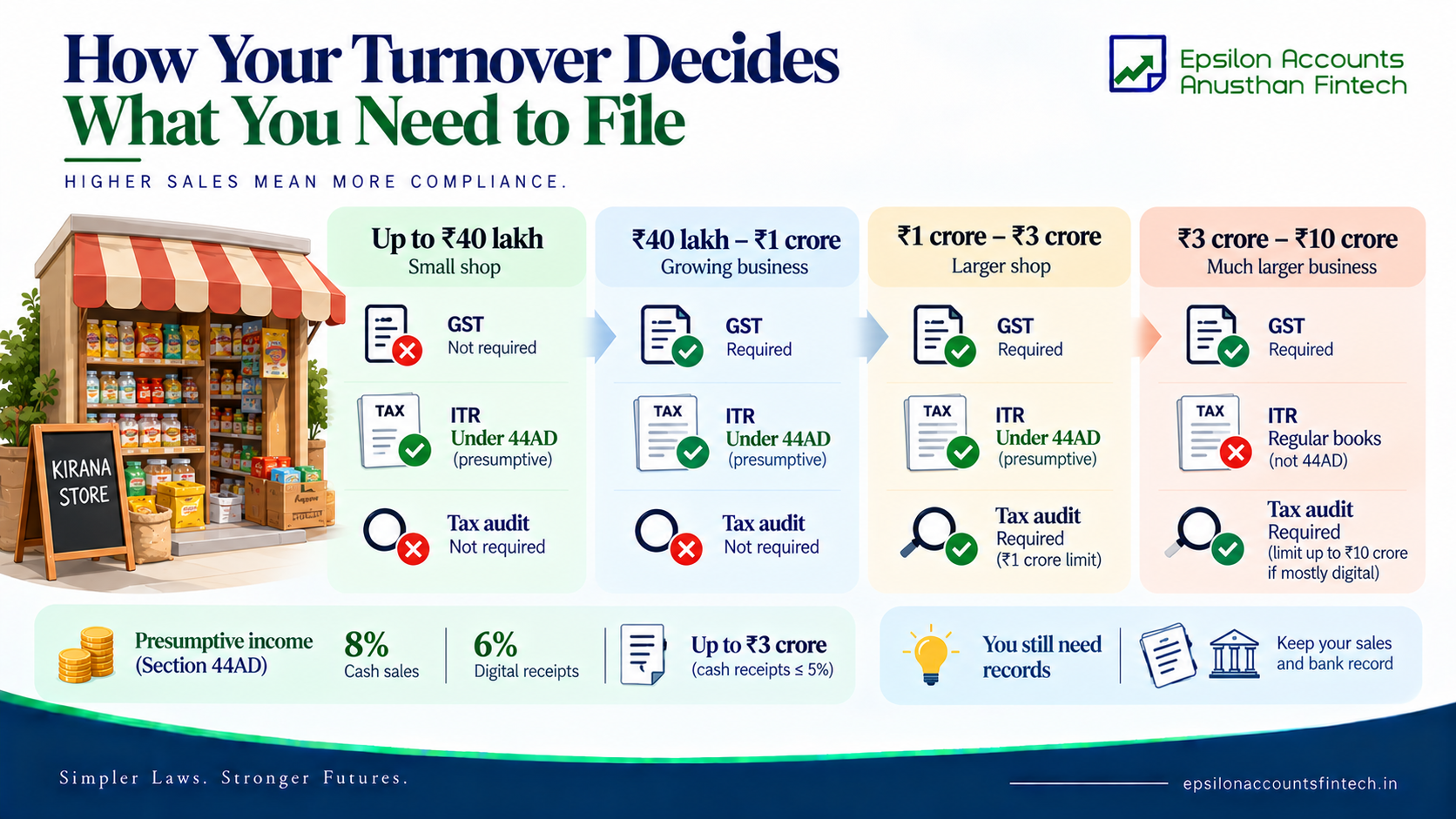
Your yearly turnover decides how much accounting work the law expects from you. Small shops can usually file income tax under a simpler presumptive scheme, skip GST below the threshold, and avoid a tax audit altogether. As sales grow, each of those reliefs falls away one by one.
Presumptive income under Section 44AD
If you’re a small trader, you can declare a fixed share of your turnover as profit instead of maintaining full books. The rate is 8% for cash sales and 6% for digital receipts, and the scheme covers turnover up to ₹3 crore when cash receipts stay within 5% (₹2 crore otherwise). This means that a kirana selling ₹40 lakh a year, mostly over UPI, can declare around ₹2.4 lakh as income and file without a balance sheet.
You might not be aware, but presumptive filing doesn’t mean you can stop keeping records. You still need proof of your turnover, and that proof is your sales and bank record.
GST and audit thresholds
GST registration usually kicks in once goods turnover crosses ₹40 lakh a year (₹20 lakh for services). A tax audit applies once turnover crosses ₹1 crore, though that limit goes up to ₹10 crore if almost all your money moves digitally.
What can a small shop safely skip?
A small shop under the GST and audit limits can usually skip double-entry ledgers, a formal balance sheet, depreciation schedules and monthly profit and loss statements. Those come later. What you can’t skip is the evidence: bills, bank statements and a sales total you can back up.
Things that can wait
- Full double-entry books: Not needed if you’re filing under the presumptive scheme and your turnover is small.
- Monthly profit reports: Nice to have, but a quarterly look is enough for most kiranas.
Things that can’t wait
- Bills for big purchases: A fridge, a counter or a new sewing machine needs its invoice, because you’ll want to show it later.
- Bank statements: Download and save them every month, since banks don’t always keep old ones easy to pull.
- Stock count at year end: Even a rough count tells you whether your declared profit makes sense.
If you’re not sure which side of these lines your shop sits on, a quick chat with someone who does this every day can save you a lot of guesswork.
When should you move from a diary to proper books?
You should move to proper books when any one of these happens: you cross the GST threshold, you apply for a bank loan, you hire staff on salary, or you open a second outlet. Each of these needs records that a diary can’t give you, mostly because someone outside your shop will want to read them.
The loan moment
Banks lending under schemes like Mudra want to see your ITR for two or three years and a bank statement that matches it. If your shop shows ₹30 lakh in UPI receipts but your ITR declares far less, the gap will be questioned. It’s why the Epsilon team asks new shop clients for twelve months of bank statements before anything else.
The staff moment
The day you put someone on a monthly salary, you need a salary record. PF and ESI follow once you cross their limits, and they’re far easier to set up early.
Frequently asked questions
What is accounting for small business in simple words?
It’s the habit of writing down every sale and expense, keeping the bills, and totalling them each month and year. For a small shop, it’s mostly a cash book, a bank record and a bill file, not complex reports.
Do small shops need to maintain books of accounts?
Yes, at a basic level. Even under presumptive taxation, you need records that prove your turnover. Full books become mandatory only when your income or turnover crosses the limits set under the Income Tax Act.
Can I do my shop accounting on my phone?
Yes. Free billing and bookkeeping apps work well for small shops if you enter sales daily. Back up the data regularly and download your bank statements separately, since apps can’t replace bank proof.
Is UPI income counted as business turnover?
Yes. Every UPI payment your shop receives for goods or services counts as turnover. That’s why mixing personal and shop UPI on one account causes confusion when your turnover is worked out.
How much does basic accounting help cost a small shop?
It varies by volume and city, but a basic monthly bookkeeping and return filing arrangement for a small shop usually costs far less than one missed penalty. Ask for a fixed monthly quote covering your exact filings.
Small business accounting support from a Thane team
Epsilon Accounts Anusthan Fintech LLP works with small traders, workshops and service businesses across Thane and Mumbai, handling day-to-day bookkeeping, GST returns, income tax filing and TDS from one team. That matters when you’re a one-person shop, because your sales record, your GST data and your ITR all need to tell the same story. The team’s accounting services are built for owners who’d rather run the counter than learn ledgers, with a monthly accounting retainership for shops that want it handled every month without chasing anyone.
You don’t need a big setup to keep clean accounts. You need the right five records, kept every day, and someone to check them before the year closes. Talk to an expert this week and find out exactly which records and filings your shop needs.