
Not always. A kirana or small trading business with turnover under the GST limit, no staff on payroll and income filed under the presumptive scheme can often manage its own records with a simple app. You need an accountant once you register for GST, take a business loan, hire salaried staff or get a tax notice. That’s the honest answer to “do you need an accountant for small business“, and it depends far more on what you file than on how big your shop looks.
Let’s be honest: most shop owners don’t want to pay someone to write down what they already know. You know your sales. You know your wholesaler. Why pay for a middleman?
It’s a fair question, and the answer changes as your business changes. This guide walks you through when doing it yourself is fine, when it starts costing you money, and what kind of help actually fits a small trader.
When can a kirana owner manage without an accountant?
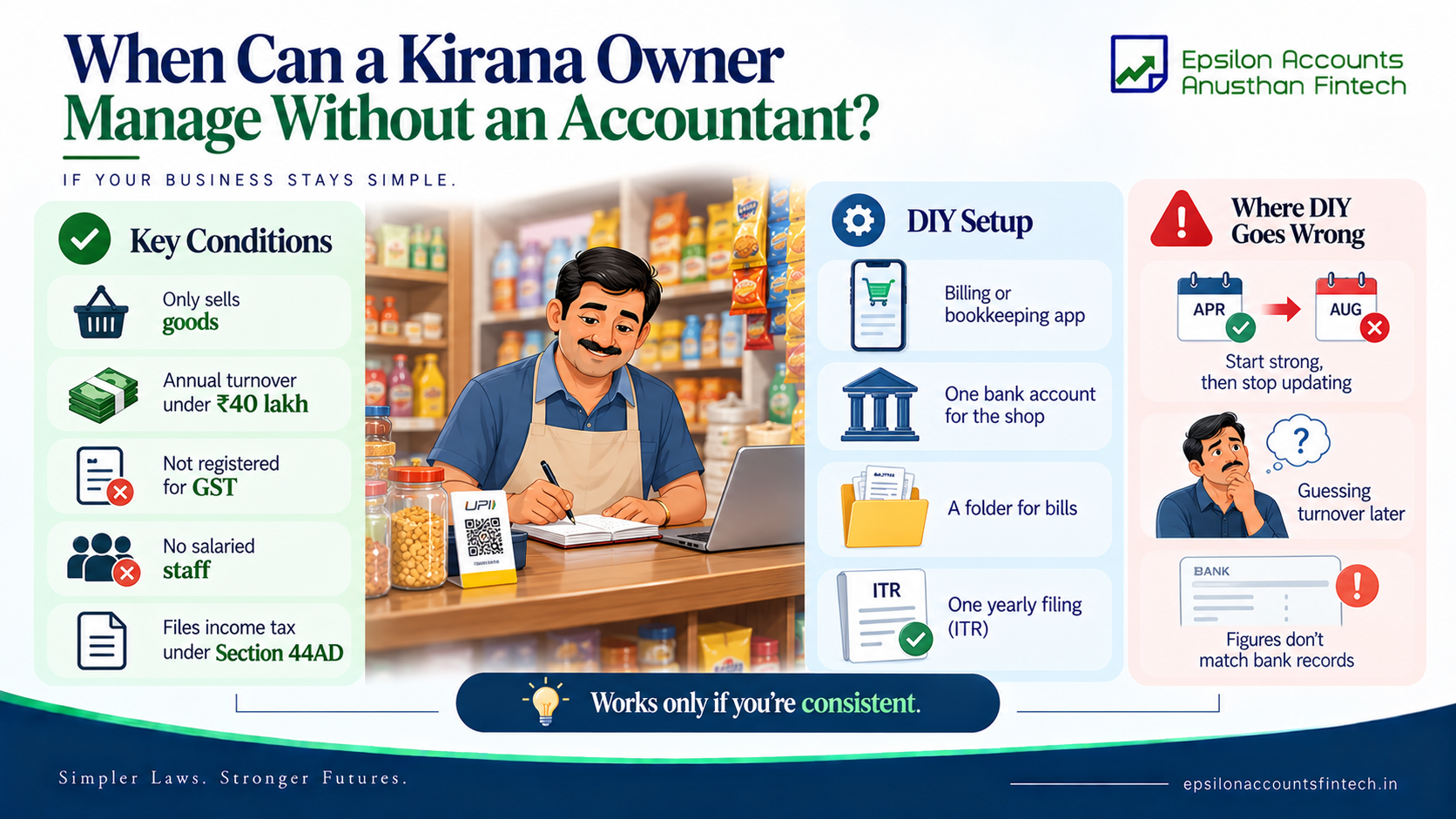
You can manage without an accountant if your shop sells only goods, stays under ₹40 lakh a year, isn’t registered for GST, has no salaried staff and files income tax under Section 44AD. In that situation, your yearly job is one simple ITR backed by a clean sales and bank record.
What the DIY setup looks like
- A billing or bookkeeping app: Free apps let you record sales, purchases and udhaar on your phone.
- One bank account for the shop: Every QR payment lands here, and nothing personal goes out of it.
- A folder for bills: Physical or photos on your phone, sorted month by month.
- One yearly filing: Your ITR, filed before the due date, with turnover matching your bank credits.
Where DIY quietly goes wrong
The thing to note here is that the DIY route works only if you’re consistent. Most shop owners start strong in April and stop updating by August. By the time the ITR is due, they’re guessing turnover from memory, and that guess rarely matches what the bank shows.
What changes once you register for GST?
Once you register for GST, you take on monthly or quarterly returns, invoice rules, input tax credit tracking and an annual return. Registration becomes mandatory for goods suppliers when turnover crosses ₹40 lakh in most states and ₹20 lakh for services, as per the threshold limits confirmed by the Finance Ministry. This is where most small traders start needing regular help.
Why GST is harder than it looks
GST isn’t one return. It’s a cycle. You raise invoices, report them in GSTR-1, pay tax through GSTR-3B, claim credit only on bills your supplier has actually uploaded, and then reconcile the whole year in an annual return. Miss one step and the late fee starts adding up daily.
The composition option
If your turnover is under ₹1.5 crore, you may qualify for the composition scheme, which means a flat low tax rate and quarterly payments instead of monthly returns. It’s simpler, but you can’t claim input credit or charge GST on your bills, so it suits some shops and hurts others. This is exactly the kind of choice where a short conversation with a professional pays off.
What are the signs you’ve outgrown doing it yourself?
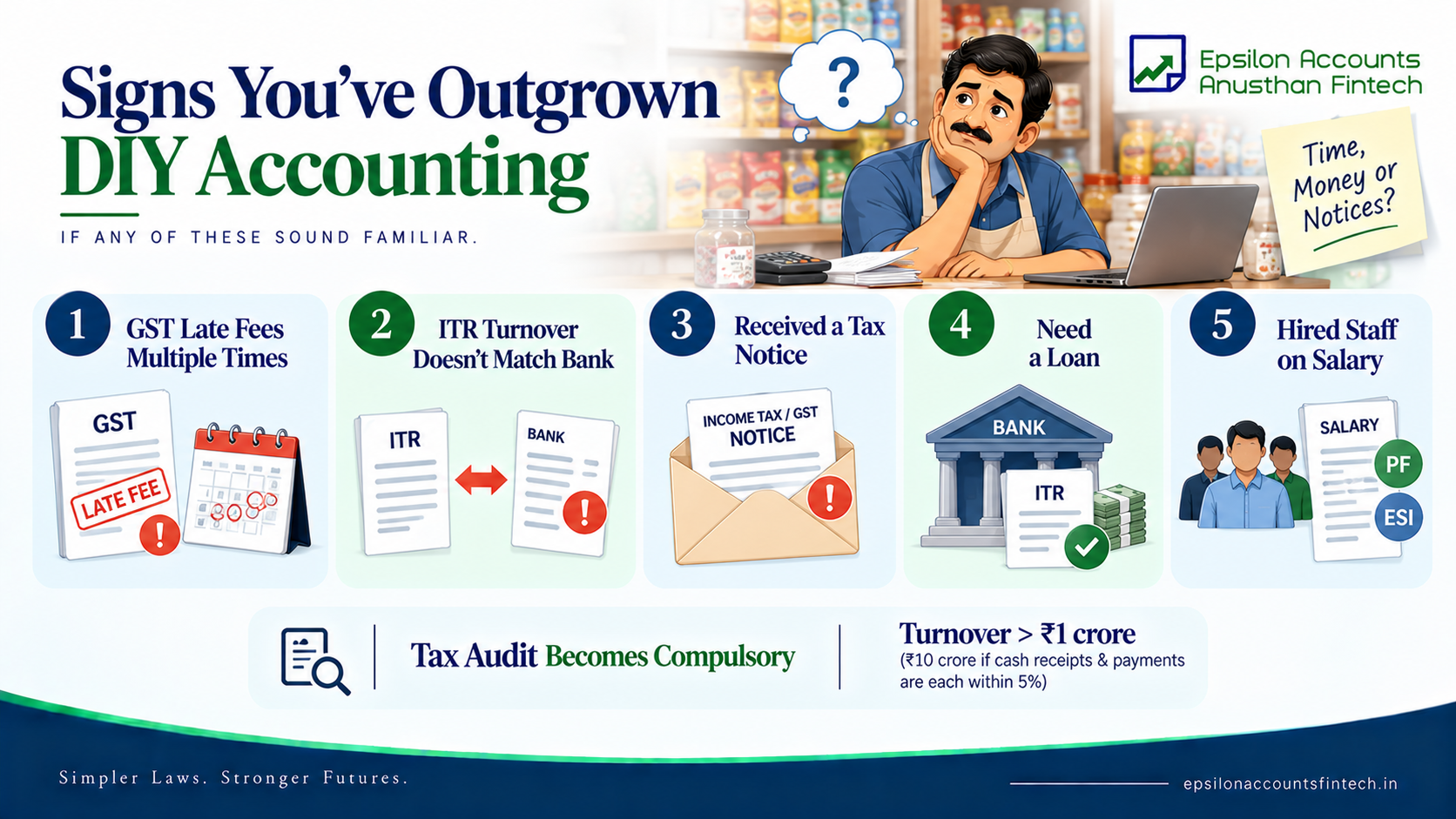
You’ve outgrown DIY accounting when you’re spending more than a few hours a month on returns, paying late fees, getting notices, or can’t say what your actual monthly profit is. Any one of these means your time or money is already leaking.
Five clear signals
- You’ve paid a GST late fee more than once: That’s the clearest sign the monthly cycle is slipping.
- Your ITR turnover doesn’t match your bank credits: The tax department can see your bank data, and gaps get questioned.
- You’ve received an income tax or GST notice: Replying wrongly can make it worse, so this isn’t one to try alone.
- You want a loan: Banks want two or three years of clean ITRs and sometimes a CA-certified statement.
- You’ve hired staff on salary: Salary records, and later PF or ESI, add a whole new layer.
The audit line
It is important for you to know that a tax audit becomes compulsory once business turnover crosses ₹1 crore, and that limit rises to ₹10 crore only when cash receipts and cash payments each stay within 5% of the total, as per the Income Tax Department’s tax audit rules. An audit has to be signed by a chartered accountant, so at that point the question of whether you need one is already answered.
If two or more of these signals sound familiar, it’s worth getting a quote before the next filing date rather than after it.
What kind of accounting help suits a small trader?
Most small traders don’t need a full-time accountant. They need either a part-time bookkeeper for daily entries, a CA firm for filings only, or a monthly retainer that covers both. The right choice depends on how many bills you handle and how many returns you file.
| Option | What you get | Best for | Rough commitment |
| Do it yourself | App plus yearly ITR | Under GST limit, no staff | A few hours a month |
| Filing-only help | GST returns and ITR filed for you | Registered, but you keep your own books | Fixed fee per filing |
| Part-time bookkeeper | Daily or weekly entries at your shop | High bill volume, no compliance knowledge | Monthly salary |
| Monthly retainership | Bookkeeping, GST, ITR and TDS by one team | Growing shops, loan seekers, staff on payroll | Fixed monthly fee |
Filing-only vs retainership
Filing-only help is cheaper on paper, but it only works if your records reach the CA clean and on time. If they don’t, you end up paying for rushed corrections. A retainership costs more per month but removes the scramble, because the same team sees your records all year.
How much does it cost to skip an accountant?
Skipping an accountant can cost more than hiring one once you add up late fees, interest on unpaid tax, lost input credit and missed loan approvals. The fee you save is visible. The losses you take usually aren’t, until the year closes.
The hidden costs
- Late fees on GST returns: They run per day, per return, and add up quickly across a year.
- Lost input tax credit: If a supplier’s bill isn’t matched in time, you pay tax you didn’t need to.
- Interest on short-paid tax: Advance tax mistakes carry monthly interest.
- A rejected loan: No penalty on paper, but it can stall your growth by a year.
You might not be aware, but unclaimed input credit is one of the most common gaps the Epsilon team finds when a trader first hands over a year of bills.
Frequently asked questions
Do you need an accountant for small business in India?
Not always. If you’re under the GST limit, file under Section 44AD and have no staff, you can manage alone. Once GST, salaried staff, loans or notices enter the picture, professional help usually saves more than it costs.
Can I file GST returns myself without a CA?
Yes, the GST portal allows it. However, you need to match invoices, track input credit and meet every due date. Most small traders find mistakes cost more than the fee they save by doing it alone.
Is a CA compulsory for filing ITR for a shop?
No. You can file your own ITR under the presumptive scheme. A CA becomes compulsory only when a tax audit applies, which depends on your turnover and how much of your business runs in cash.
What does an accountant do for a kirana store?
They record sales and purchases, file GST and income tax returns, track input credit, reconcile bank statements and flag due dates. For larger stores they also handle staff salaries, TDS and the yearly balance sheet.
Should a small shop hire a full-time accountant?
Usually no. A full-time salary rarely makes sense for a single shop. A part-time bookkeeper or a monthly retainership with a firm gives you the same coverage at a lower and more predictable cost.
Accounting help that fits a small trader’s budget
Epsilon Accounts Anusthan Fintech LLP supports kiranas, wholesalers and small traders in Thane and Mumbai with a mix of bookkeeping, GST retainership and yearly income tax filing, all handled by the same team. The point isn’t to load you with services you don’t need. It’s to match the help to where your shop actually is today, and scale it only when your filings do.
You don’t need an accountant for the sake of having one. You need one the moment your filings start costing you time, fees or sleep. Talk to an expert about your turnover and filings, and get a straight answer on whether you need help yet.