Summary: From around July 2026, GST filing is becoming stricter as the government moves to hard-lock input tax credit (ITC) in GSTR-3B. Following the July 2025 change that locked outward liability, the next phase restricts ITC to what is auto-populated from GSTR-2B, meaning manual over-claiming will no longer be possible. Combined with the Invoice Management System (IMS), businesses must now reconcile invoices carefully before filing. Getting your reconciliation and vendor compliance right is now essential, and a good chartered accountants firm can help you stay compliant and protect your credit.
GST compliance is changing again in July 2026, and this round of changes directly affects the input tax credit you can claim.
If your business claims ITC, and almost every business does, these changes matter to your cash flow and compliance. Getting them wrong could mean lost credit or automated mismatch notices.
This guide explains exactly what is changing, why, and what your business needs to do to stay compliant.
What are the main GST filing changes in July 2026?
The main GST filing change in July 2026 is the move to hard-lock input tax credit (ITC) in GSTR-3B. This means the ITC you can claim will be restricted to what is auto-populated from your GSTR-2B, and manual editing to claim extra credit will no longer be allowed. It builds on the July 2025 change that already locked outward tax liability.
This is part of a phased tightening of GST filing.
The government first locked the outward liability fields in GSTR-3B, auto-populated from GSTR-1, from the July 2025 tax period. The ITC (Table 4) hard-locking is the next phase, targeted for around July 2026, completing the shift to a system-driven return.
In short, GSTR-3B is becoming a largely auto-populated, non-editable return. What flows in from your GSTR-1 and GSTR-2B is what you file.
What is ITC hard-locking and how does it affect you?
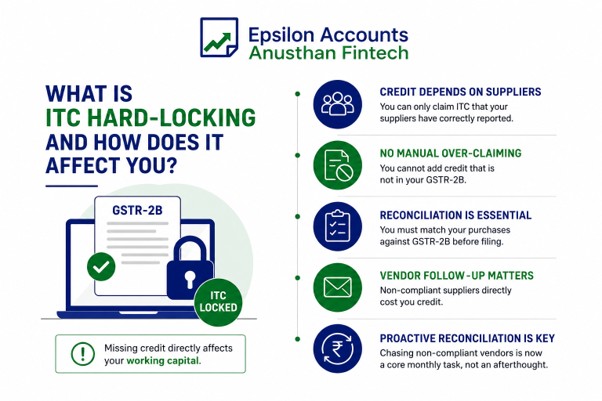
ITC hard-locking means the input tax credit in your GSTR-3B is fixed to the amount auto-populated from GSTR-2B, and you cannot manually increase it. If a supplier has not correctly reported an invoice, that credit will not appear in your GSTR-2B, so you cannot claim it, making vendor compliance critical to protecting your ITC.
The impact on businesses is significant:
- Credit depends on suppliers: you can only claim ITC that your suppliers have correctly reported.
- No manual over-claiming: you cannot add credit that is not in your GSTR-2B.
- Reconciliation is essential: you must match your purchases against GSTR-2B before filing.
- Vendor follow-up matters: non-compliant suppliers directly cost you credit.
This is why proactive reconciliation and chasing non-compliant vendors is now a core monthly task, not an afterthought. Missing credit directly affects your working capital.
How does the Invoice Management System (IMS) fit in?
The Invoice Management System (IMS) lets you accept, reject, or keep pending each supplier invoice before it flows into your GSTR-2B and GSTR-3B. It matters because if you take no action on an invoice before GSTR-2B is generated, the system may treat it as accepted automatically, so ignoring IMS can pull incorrect credit into your return.
IMS is central to the new system.
Under IMS, an invoice on which you take no action before GSTR-2B is generated is automatically treated as accepted and flows into your ITC. This means passively ignoring the system can result in wrong or ineligible credit entering your return.
To use IMS well, review your supplier invoices each month and act on them deliberately, accepting genuine ones and rejecting incorrect ones before your GSTR-2B is finalised.
What should businesses do to stay compliant?
To stay compliant, businesses should reconcile purchases against GSTR-2B every month, act on invoices in IMS before the cut-off, follow up with non-compliant suppliers, and file accurately and on time. These steps protect your ITC and avoid automated mismatch notices under the new locked system.
Follow this monthly checklist:
| Step | Action |
| Reconcile | Match your purchase records against GSTR-2B |
| Review IMS | Accept or reject supplier invoices before the cut-off |
| Chase vendors | Follow up suppliers who have not reported invoices |
| File correctly | Ensure GSTR-1 and GSTR-3B are accurate and timely |
| Keep records | Maintain clear documentation for every claim |
Businesses in Thane and Mumbai are increasingly turning to a professional ca company in Mumbai to manage this monthly reconciliation, precisely because the margin for error has narrowed. Getting it wrong now directly costs credit.
Why professional help matters more than ever?
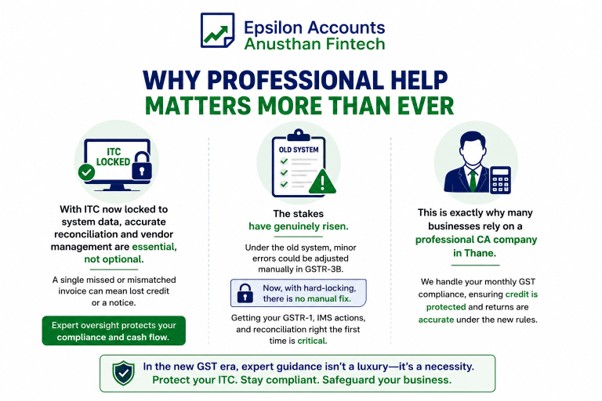
With ITC now locked to system data, accurate reconciliation and vendor management have become essential rather than optional. A single missed or mismatched invoice can mean lost credit or a notice, so expert oversight protects both your compliance and your cash flow.
The stakes have genuinely risen.
Under the old system, minor errors could be adjusted manually in GSTR-3B. Now, with hard-locking, there is no manual fix, so getting your GSTR-1, IMS actions, and reconciliation right the first time is critical.
This is exactly why many businesses rely on a professional ca company in Thane to handle monthly GST compliance, ensuring credit is protected and returns are accurate under the new rules.
Frequently asked questions
What is changing in GST filing from July 2026? From around July 2026, input tax credit (ITC) in GSTR-3B is being hard-locked to the amount auto-populated from GSTR-2B. This means you cannot manually claim extra credit, so accurate reconciliation and supplier compliance become essential to protect your ITC.
Can I still edit ITC in GSTR-3B? Under ITC hard-locking, you will no longer be able to manually increase the ITC in GSTR-3B beyond what is auto-populated from GSTR-2B. Any corrections must flow through the proper channels, such as supplier corrections in GSTR-1 and actions in the IMS.
What happens if my supplier does not report an invoice? If a supplier does not correctly report an invoice, it will not appear in your GSTR-2B, so you cannot claim that input tax credit under the new locked system. This is why following up with non-compliant suppliers is now essential to protect your credit.
Do I have to use the Invoice Management System (IMS)? Yes, you should actively use IMS. If you take no action on invoices before GSTR-2B is generated, they may be treated as accepted automatically. Reviewing and acting on invoices in IMS each month ensures only correct credit flows into your return.
How can a CA firm help with the new GST rules? A CA firm can manage your monthly reconciliation against GSTR-2B, handle IMS actions, follow up with non-compliant vendors, and ensure accurate, timely filing. This protects your input tax credit and avoids mismatch notices under the stricter hard-locked system.
Why choose Epsilon for GST compliance
As GST filing becomes stricter and more system-driven, expert compliance support matters more than ever, and this is where Epsilon helps businesses across Thane and Mumbai.
The firm manages end-to-end GST compliance, from monthly GSTR-2B reconciliation and IMS management to accurate filing and vendor follow-up, so your input tax credit stays protected under the new rules. Businesses receive proactive, expert guidance rather than last-minute scrambling before deadlines.
That proactive, expertise-led approach is what makes the firm a trusted name for GST and tax compliance in Thane and Mumbai.
The July 2026 GST changes mark a decisive shift toward a locked, system-driven filing regime where accuracy and reconciliation are everything. Businesses that adapt their processes now will protect their credit and avoid notices, while those that do not risk losing money. To make sure your GST compliance is ready for the new rules, get in touch with our team today for expert support.