
Summary: You can check a GST registration’s active status for free on the GST portal by using the Search Taxpayer tool with the GSTIN, no login needed. This shows whether the registration is Active, Cancelled, or Suspended in seconds. If you’re tracking a new registration application instead, use Track Application Status with your ARN. Businesses should verify a vendor’s GST status before onboarding and periodically afterwards, since paying a supplier whose registration has lapsed can put your input tax credit at risk.
A GSTIN on an invoice looks reassuring. Whether it’s actually live is a different question, and one that’s worth thirty seconds of your time before you rely on it.
This matters more than it used to. With GSTR-3B input tax credit now locked to what your suppliers actually report, a vendor whose registration has quietly gone inactive can turn into a compliance headache you never saw coming.
Here’s exactly how to check, what each status means, and why it’s worth building into how your business works with vendors.
How do you check GST active status online?
,
You check GST active status online through the GST portal’s free Search Taxpayer tool, using either the GSTIN or the legal business name, with results shown instantly and no login required. If you’re checking a new application rather than an existing registration, you’ll use a separate ARN-based tracker instead.
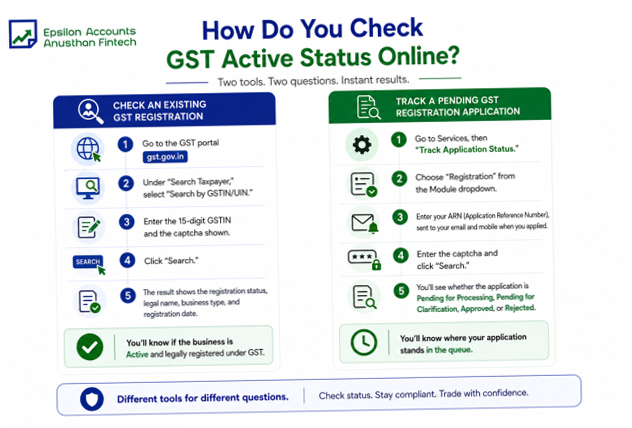
Checking an existing GST registration
- Go to the GST portal at gst.gov.in.
- Under “Search Taxpayer,” select “Search by GSTIN/UIN.”
- Enter the 15-digit GSTIN and the captcha shown.
- Click “Search.”
- The result shows the registration status, legal name, business type, and registration date.
Tracking a pending registration application
- Go to Services, then “Track Application Status.”
- Choose “Registration” from the Module dropdown.
- Enter your ARN (Application Reference Number), sent to your email and mobile when you applied.
- Enter the captcha and click “Search.”
- You’ll see whether the application is Pending for Processing, Pending for Clarification, Approved, or Rejected.
These are genuinely different tools for different questions. One tells you whether a business is currently registered and trading legally under GST. The other tells you where a fresh application stands in the queue.
What do the different GST statuses actually mean?
A GST status of “Active” means the business is currently registered and legally entitled to collect tax and pass on input tax credit. Anything else, Cancelled, Suspended, or Provisional, signals a registration that isn’t fully valid for normal trading, and each carries different practical implications for anyone dealing with that business.
| Status shown | What it means |
| Active | Registration is current; the business can legally invoice with GST |
| Cancelled | Registration has been withdrawn or revoked; GST charged is not valid |
| Suspended | Registration is under review, often pending a cancellation decision |
| Provisional | Registration is newly issued and yet to be fully confirmed |
| Pending for Order | An application is filed and awaiting a decision from the officer |
A cancelled or suspended GSTIN on an incoming invoice is the one that should stop you before you pay it.
Why does checking GST active status matter for your business?
Checking GST active status matters because paying a supplier whose registration has been cancelled puts your input tax credit at risk and can trigger reconciliation problems you only discover months later. With GSTR-3B now locking credit to what suppliers actually file, an inactive vendor stops contributing usable credit the moment their registration lapses.
The scale of the problem is worth knowing. In a written reply to the Rajya Sabha, the Ministry of Finance disclosed that 11,193 fake GST registrations obtained through forged PAN and Aadhaar documents were detected over three years, tied to fraudulent input tax credit worth roughly Rs 38,134 crore. Genuine businesses that unknowingly transacted with these entities were the ones left untangling the credit fallout.
It also helps to remember the scale you’re operating in. GSTN’s own data puts the country at 1,53,56,323 active GST taxpayers as of June 2025, a number large enough that manually keeping track of every vendor’s standing simply isn’t realistic without a system for it.
None of this means every new vendor is suspicious. It means a thirty-second check before onboarding, and again periodically, costs almost nothing against the risk of finding out the hard way.
What should you do if a GSTIN shows as cancelled or suspended?
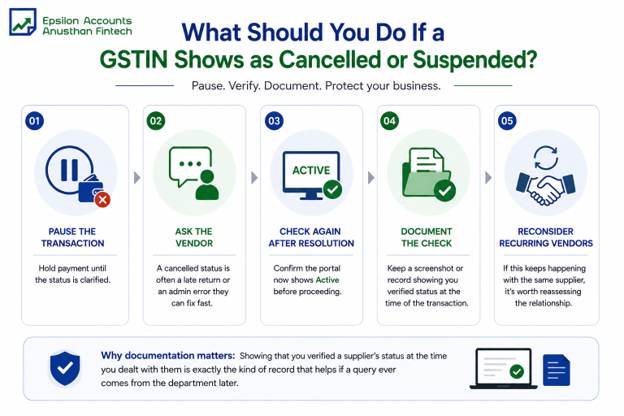
If a vendor’s GSTIN shows as cancelled or suspended, pause payment and ask them directly for an explanation before proceeding, since the reason could range from an administrative lapse to something more serious. Genuine businesses usually resolve this quickly and can show you evidence of reactivation or a fresh registration.
A sensible response looks like this:
- Pause the transaction: hold payment until the status is clarified.
- Ask the vendor: a cancelled status is often a late return or an admin error they can fix fast.
- Check again after resolution: confirm the portal now shows Active before proceeding.
- Document the check: keep a screenshot or record showing you verified status at the time of the transaction.
- Reconsider recurring vendors: if this keeps happening with the same supplier, it’s worth reassessing the relationship.
That last point of documentation matters more than it seems. Showing that you verified a supplier’s status at the time you dealt with them is exactly the kind of record that helps if a query ever comes from the department later.
How often should businesses actually verify their vendors?
Businesses should verify a new vendor’s GST status before the first transaction and then periodically, ideally monthly for regular suppliers, rather than treating the initial check as a one-time task. Registrations can be cancelled at any point, so a vendor who was active in January isn’t guaranteed to still be active in June.
This kind of ongoing monitoring is exactly where most businesses run out of bandwidth, since it competes with actual operations for time. It’s also why many businesses now bring in a chartered accountant on retainership basis, so vendor checks, reconciliation, and cashflow monitoring happen as routine work rather than something that only gets attention after a problem surfaces.
Frequently asked questions
How do I check if a GST number is active or cancelled? Use the Search Taxpayer tool on the GST portal with the GSTIN. It instantly shows whether the registration is Active, Cancelled, or Suspended, along with the legal business name, no login or fee required.
What does “GST registration status: Active” mean? It means the business is currently and legally registered under GST, entitled to charge tax and pass on valid input tax credit. Any status other than Active signals the registration isn’t fully valid for normal ongoing trading.
Can I check another business’s GST status using only their GSTIN? Yes. The GST portal’s Search Taxpayer tool is public, requires no login, and works with either the GSTIN or the business’s legal name to return the current registration status.
How long does it take for a new GST registration to become active? Typically 3 to 7 working days after a complete application, though it can take longer if documents need clarification. You can track progress in real time using the ARN-based Track Application Status tool.
What happens if I claim ITC from a supplier whose GSTIN was cancelled? That credit can be blocked or reversed, and you may face a notice asking you to justify the claim. Checking status before paying, and keeping a record of that check, is the simplest way to avoid this.
Why choose Epsilon for GST compliance support
Because vendor risk is easy to miss until it shows up as blocked credit, having someone actively watching for it is worth more than checking a portal occasionally on your own.
Epsilon supports businesses across Thane and Mumbai as a full-service chartered accountants firm, handling GST consultancy services, vendor and GSTIN verification, monthly reconciliation, and cashflow monitoring as part of ongoing, retainership-based support rather than reactive fixes. Clients get a genuine gst and income tax consultant keeping watch, not just someone who files returns when the deadline arrive
A GSTIN is only as good as its current status, and that status can change without any warning to you. Building a thirty-second check into how you onboard and manage vendors is a small habit that protects real money. If you’d rather this ran quietly in the background of your business, get in touch with our team today.