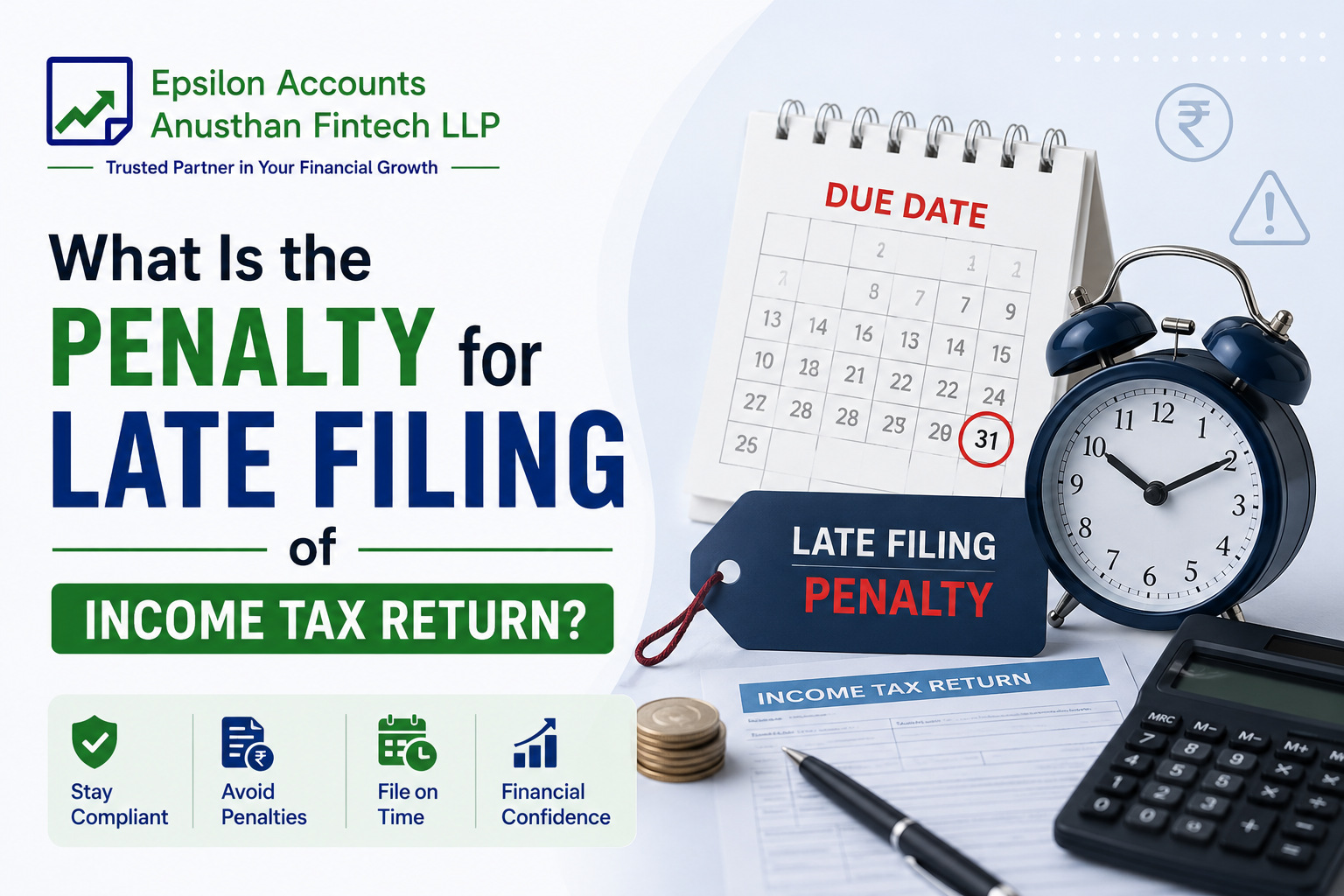

Summary: The ITR filing last date for FY 2025-26 (AY 2026-27) is 31 July 2026 for most salaried individuals filing ITR-1 or ITR-2. Businesses needing an audit have later dates. Missing the deadline means a late fee of up to Rs 5,000 under Section 234F (Rs 1,000 if income is below Rs 5 lakh), interest on unpaid tax, and the loss of certain benefits like carrying forward losses. A belated return can still be filed until 31 December 2026. Filing on time protects your refund and avoids penalties, and a chartered accountants firm can ensure it is done correctly.
Tax season is here, and the clock is ticking on the ITR filing deadline for FY 2025-26.
Filing on time is not just about compliance; it protects your refund, avoids penalties, and preserves valuable benefits. Missing the date can cost you money in more ways than one.
This guide covers the exact deadlines, the penalties for late filing, and what to do if you miss the date.
What is the ITR filing last date for 2026?
The ITR filing last date for FY 2025-26 (AY 2026-27) is 31 July 2026 for salaried individuals and others not requiring an audit, filing ITR-1 or ITR-2. Businesses and professionals requiring an audit have later deadlines. Filing by your applicable due date avoids penalties and protects your right to certain tax benefits.
The deadline depends on your category of taxpayer.
For most individuals, the due date for FY 2025-26 is 31 July 2026. Those whose accounts need auditing, such as many businesses, have extended deadlines later in the year.
Here are the key dates:
| Taxpayer category | Due date |
| Salaried individuals (ITR-1/ITR-2) | 31 July 2026 |
| Non-audit business (ITR-3/ITR-4) | 31 August 2026 |
| Audit cases | 31 October 2026 |
| Belated or revised return | 31 December 2026 |
What are the penalties for late filing?
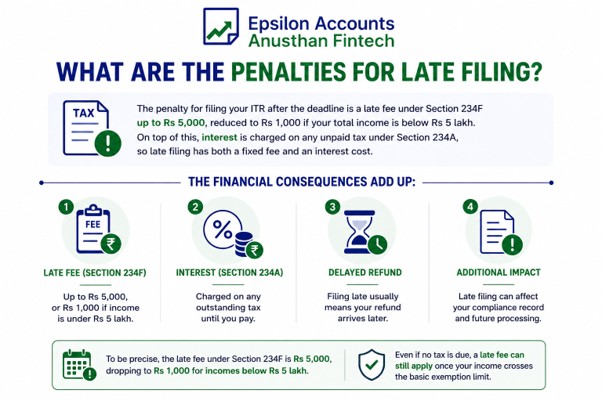
The penalty for filing your ITR after the deadline is a late fee under Section 234F of up to Rs 5,000, reduced to Rs 1,000 if your total income is below Rs 5 lakh. On top of this, interest is charged on any unpaid tax under Section 234A, so late filing has both a fixed fee and an interest cost.
The financial consequences add up:
- Late fee (Section 234F): up to Rs 5,000, or Rs 1,000 if income is under Rs 5 lakh.
- Interest (Section 234A): charged on any outstanding tax until you pay.
- Delayed refund: filing late usually means your refund arrives later.
To be precise, the late fee under Section 234F is Rs 5,000, dropping to Rs 1,000 for incomes below Rs 5 lakh. Even if no tax is due, a late fee can still apply once your income crosses the basic exemption limit.
What benefits do you lose by filing late?
Filing your ITR late means losing the ability to carry forward certain losses, such as business or capital losses, to offset against future income. You also face interest on unpaid tax and delayed refunds. These losses of benefit often cost far more than the late fee itself, especially for businesses and investors.
The hidden costs of late filing include:
- Loss carry-forward: you cannot carry forward most losses to future years.
- Interest costs: interest accrues on any tax you owe.
- Delayed refunds: your refund is processed later than for timely filers.
- Compliance stress: late filing can invite closer scrutiny.
For businesses and investors, the inability to carry forward losses can be particularly expensive, as it removes a valuable way to reduce future tax. This is why timely filing matters well beyond simply avoiding the fee.
Can you still file after the deadline?
Yes, if you miss the 31 July 2026 deadline, you can file a belated return until 31 December 2026 under Section 139(4). However, a belated return attracts the late fee and interest, and you lose certain benefits like carrying forward losses. Filing belated is far better than not filing at all, but on-time filing is always preferable.
A belated return is a safety net, not a substitute for timely filing.
You can file a belated return up to 31 December 2026, but it comes with the late fee, interest, and the loss of certain benefits. If you also need to correct a filed return, a revised return can generally be filed within the same window.
The key message is simple: if you have missed the deadline, still file, because not filing at all carries far greater risks, including notices and higher penalties.
How can you file your ITR correctly and on time?
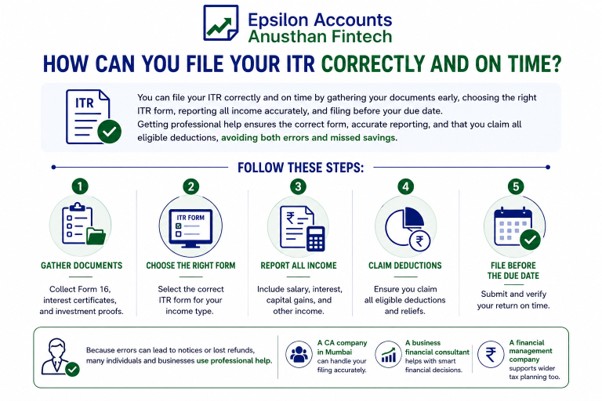
You can file your ITR correctly and on time by gathering your documents early, choosing the right ITR form, reporting all income accurately, and filing before your due date. Getting professional help ensures the correct form, accurate reporting, and that you claim all eligible deductions, avoiding both errors and missed savings.
Follow these steps:
- Gather documents: collect Form 16, interest certificates, and investment proofs.
- Choose the right form: select the correct ITR form for your income type.
- Report all income: include salary, interest, capital gains, and other income.
- Claim deductions: ensure you claim all eligible deductions and reliefs.
- File before the due date: submit and verify your return on time.
Because errors can lead to notices or lost refunds, many individuals and businesses use professional help. A ca company in Mumbai or business financial consultant can handle your filing accurately, and a financial management company can support wider tax planning too.
Frequently asked questions
What is the last date to file ITR for FY 2025-26? The last date is 31 July 2026 for salaried individuals and others not requiring an audit, filing ITR-1 or ITR-2. Non-audit businesses have until 31 August 2026, and audit cases until 31 October 2026. A belated return can be filed until 31 December 2026.
What is the penalty for filing ITR late? The late fee under Section 234F is up to Rs 5,000, reduced to Rs 1,000 if your total income is below Rs 5 lakh. Interest under Section 234A also applies on any unpaid tax, so late filing carries both a fixed fee and an interest cost.
Can I file my ITR after 31 July 2026? Yes, you can file a belated return until 31 December 2026 under Section 139(4). However, it attracts the late fee and interest, and you lose benefits like carrying forward losses. Filing belated is much better than not filing, but on-time filing is always preferable.
What happens if I do not file my ITR at all? Not filing can lead to penalties, interest, notices from the tax department, and prosecution in serious cases. You also lose refunds you may be owed and the ability to carry forward losses. It is always better to file, even belatedly, than not to file at all.
Do I need to file ITR if no tax is payable? Often yes. Even if no tax is payable, you may need to file if your income exceeds the basic exemption limit, and a late fee can still apply. Filing also lets you claim refunds and carry forward losses, so it is usually worthwhile regardless.
Why choose Epsilon for ITR filing
Because accurate, timely ITR filing protects your refund and avoids penalties, expert support is valuable, and this is where Epsilon helps individuals and businesses across Thane and Mumbai.
The firm handles ITR filing end to end, from selecting the right form and reporting income accurately to claiming all eligible deductions and filing before the deadline. Clients receive careful, expert filing that avoids errors, penalties, and missed savings, backed by wider tax and financial guidance.
That accurate, timely approach is what makes the firm a trusted name for income tax return filing in Thane and Mumbai.
The ITR filing deadline of 31 July 2026 is one date worth marking clearly, because filing on time protects your refund, avoids penalties, and preserves valuable tax benefits. Whether your return is simple or complex, filing accurately and early is always the smart move. To file your ITR correctly and on time, get in touch with our team today.