TLDR
- Late filing can trigger a fee under section 234F. For AY 2026-27, a belated return can be filed up to 31 December 2026, subject to the law and completion of assessment.
- A salaried person with freelance income usually files ITR-3. ITR-4 works only for eligible presumptive income cases under sections 44AD, 44ADA, or 44AE.
- A Pvt Ltd company must still file its return, even in a loss year. For companies, the applicable form is ITR-6.
- Missing contractor TDS can create interest, penalty exposure, and a 30% disallowance of the expense in business income.
According to the Income Tax Department, AY 2026-27 relates to FY 2025-26, and the return is filed on the older ITR framework for that assessment year. The due date for non-audit cases is 31 July 2026, with belated filing available later, but fees can apply.
That matters because many people wait until the last week. Then they discover a missing Form 16A, an unmatched AIS entry, or freelance income that changes the form. Small mistakes can become costly.
This guide clears the most common filing doubts. It shows which ITR to use, what happens when returns are late, how to handle TDS errors, and when a CA can rebuild weak books. It is written for salaried taxpayers, freelancers, and business owners in Mumbai, Thane, and Wagle Estate.
What happens if you file your income tax return late?
If you miss the due date under section 139(1), you may still file a belated return. For AY 2026-27, the Income Tax Department FAQ says belated filing can be made up to 31 December 2026, or earlier if assessment is completed.
The most common cost is the late fee under section 234F. The department states that the fee is ₹1,000 where total income does not exceed ₹5 lakh, and ₹5,000 in other cases. Interest on any unpaid tax can also apply.
Late filing can also delay refunds and complicate compliance records. For taxpayers who want a cleaner tax history, filing on time is the safer path.
Which ITR form should a salaried employee with freelance income use?
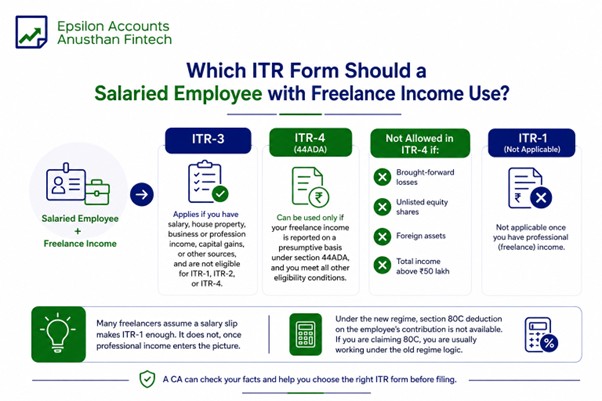
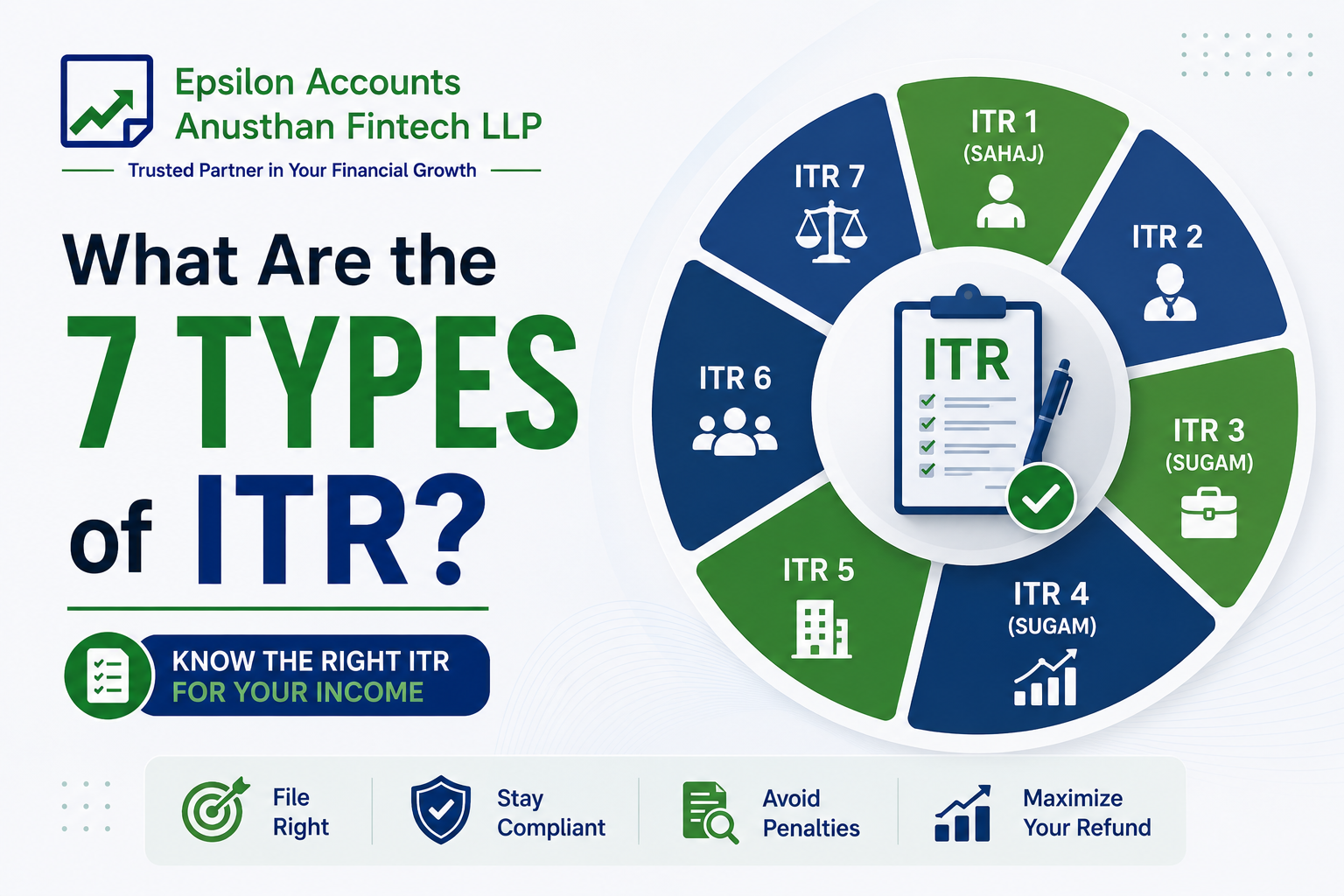
A salaried person with freelance income usually falls outside ITR-1. The department’s AY 2026-27 guidance says ITR-3 applies to individuals and HUFs having salary, house property, business or profession income, capital gains, or other sources, when they are not eligible for ITR-1, ITR-2, or ITR-4.
ITR-4 can be used only when the freelance work is reported on a presumptive basis under section 44ADA, and the person meets the other eligibility rules. It is not allowed if there are brought-forward losses, unlisted equity shares, foreign assets, or total income above ₹50 lakh.
This is where many Mumbai freelancers go wrong. They assume a salary slip makes ITR-1 enough. It does not, once professional income enters the picture. A CA can check whether ITR-3 or ITR-4 is correct before filing.
Another point matters under the new regime. The department’s own table shows that section 80C deduction on the employee’s contribution is not available in the new tax regime. If you are claiming 80C, you are usually working under the old regime logic.
Does a Pvt Ltd company need to file a return even if it made a loss?
Yes. A company does not stop filing because it had no profit. The department says ITR-6 is the applicable return for companies other than those claiming exemption under section 11. That includes an Indian company.
A loss year still matters for compliance, financial reporting, and future review. A company return keeps the tax record current and avoids gaps in filing history. The right form remains ITR-6, not a personal return form.
For founders in Thane and Mumbai, this is a common end-of-year clean-up task. Epsilon Accounts Fintech lists income tax filing services for individuals and companies, along with accounting support and financial management services.
What should you do if you missed TDS on a contractor payment?
First, fix the deduction and deposit process fast. The Income Tax Department says that if TDS is not deducted, interest under section 201 applies at 1% per month or part of the month until deduction. If TDS is deducted but not deposited, the interest is 1.5% per month or part of the month.
Second, check the expense impact. The department states that under section 40(a)(ia), 30% of certain resident payments, including contractor or subcontractor payments, can be disallowed if tax was deductible but not deducted, or deducted but not paid by the return due date.
Third, prepare for possible penalty exposure in serious defaults. The department’s TDS pages note penalty and prosecution consequences where tax is not deducted or not deposited.
In practice, the clean-up steps are simple. Recompute the payment, deduct the correct TDS, deposit it, file the TDS statement, and reconcile the challan with Form 26AS and AIS. That reduces future mismatch issues.
Can a CA rebuild books if accounts were not maintained properly?
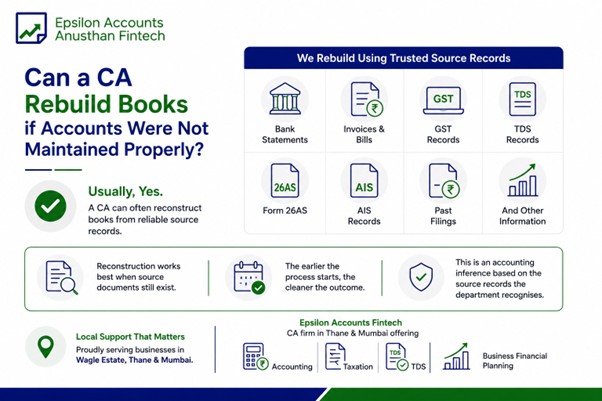
Usually, yes. A CA can often reconstruct books from bank statements, invoices, GST records, TDS records, Form 26AS, AIS, and past filings. The department’s portal itself uses Form 26AS and AIS as key reference records for TDS, taxes paid, refunds, and other information.
Reconstruction works best when source documents still exist. Bank statements, vendor bills, salary data, GST returns, and contract notes help rebuild sales, purchases, expenses, and liabilities. The earlier the process starts, the cleaner the outcome. This is an accounting inference based on the source records the department recognises.
For businesses in Wagle Estate, Thane, and Mumbai, local support can matter. Epsilon Accounts Fintech positions itself as a CA firm in Thane and Mumbai with accounting, taxation, TDS, and business financial planning services.
Why does local CA support help taxpayers in Mumbai and Thane?
Local support saves time during filing season. It also helps when documents, AIS mismatches, TDS problems, or company records need quick review. Epsilon Accounts Fintech’s homepage highlights income tax filing, accounting services, business financial planning, and TDS support in Thane and Mumbai.
That matters for salaried taxpayers, freelancers, contractors, and company owners. Each case needs the right form, the right tax regime check, and the right supporting records. A nearby CA team can coordinate all three faster.
Frequently asked questions
Can I file ITR after the due date?
Yes. For AY 2026-27, a belated return can be filed until 31 December 2026, or earlier if assessment is completed. A late fee may still apply.
Which form should I use if I earn salary and freelance income?
Usually ITR-3. Use ITR-4 only if your freelance income is eligible under presumptive taxation and you meet the other conditions.
Do companies file returns even when they have losses?
Yes. Companies file ITR-6. Losses do not remove the filing requirement.
Can I claim 80C in the new tax regime?
No. The department’s employee benefits table shows section 80C deduction is not available in the new tax regime.
Filing on time keeps penalties low and records clean. The right ITR form keeps your return valid. TDS fixes protect your business expenses. And proper bookkeeping keeps future filing easier. For support with tax filing, TDS, accounting, and company compliance in Thane or Mumbai, talk to Epsilon Accounts Fintech.