Summary
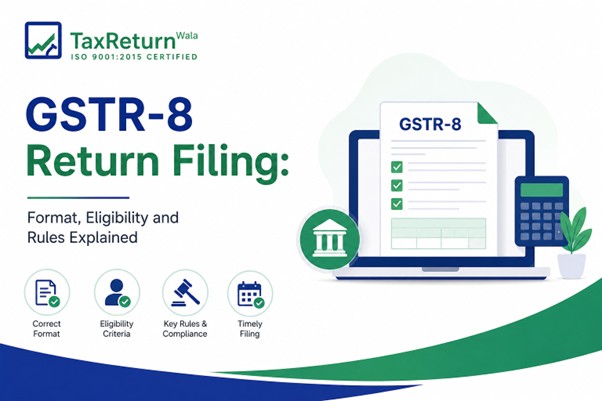
GSTR-8 is the monthly TCS statement for registered e-commerce operators. It reports supplies made through the platform and tax collected at source. The due date is the 10th day of the next month. Late fee applies for return periods from October 2022 onwards. Interest applies if TCS is paid late. The form has three main parts: Table 3, Table 4, and Table 5. Table 3 holds supply details, Table 4 holds amendments, and Table 5 auto-calculates interest. At Epsilon Accounts Anusthan Fintech LLP, businesses in Thane get GST, income tax, and compliance support from a local CA firm with strong tax experience.
Introduction
According to the GST portal, GSTR-8 is mandatory for registered e-commerce operators that collect TCS on supplies made through their platform. That makes it a critical compliance return, not a routine form.
Many businesses miss it because the rules look technical. The confusion grows when amendments, POS rules, and late fee checks appear together.
This guide explains the format, eligibility, deadlines, and filing rules in simple language. It also shows how a CA company in Thane and a gst and income tax consultant can reduce filing errors.
What is GSTR-8 and who has to file it?
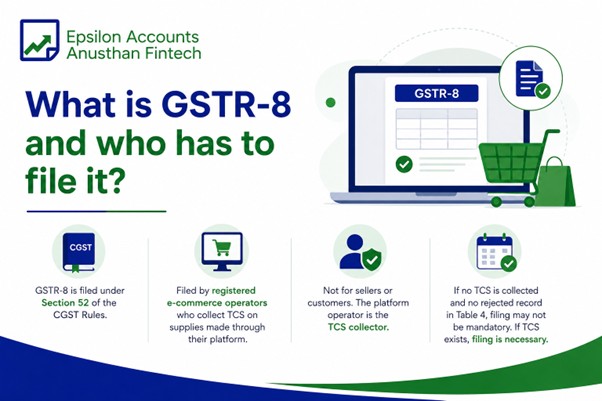
GSTR-8 is the statement that e-commerce operators file under section 52 of the CGST Rules. It captures supplies made through the platform and the TCS collected on those supplies.
The return is meant for every registered e-commerce operator required to collect TCS on outward supplies of goods or services made by taxable persons through the platform.
It is not meant for ordinary sellers or end customers. The platform operator files it because GST law treats the operator as the TCS collector for those supplies.
A useful rule is this: if no TCS is collected and no rejected record appears in Table 4, filing may not be mandatory for that period. If TCS exists, filing becomes necessary.
What is the format of GSTR-8?
GSTR-8 has a simple structure, but each table must be filled carefully. The GST portal lists three main tables in the form.
| Table | What it contains | Filing mode |
| Table 3 | Details of supplies attracting TCS | Online or offline utility |
| Table 4 | Amendments to earlier TCS details | Online or offline utility |
| Table 5 | Interest on late payment of TCS | Auto-calculated on the portal |
Table 3 holds the original supply data. Table 4 is used when earlier data needs correction. Table 5 is generated automatically when interest becomes payable.
From April 2025 tax periods onwards, the Place of Supply must be chosen from the POS dropdown while entering records. You also cannot use the same POS for the same GSTIN in one month.
What are the key filing rules for GSTR-8?
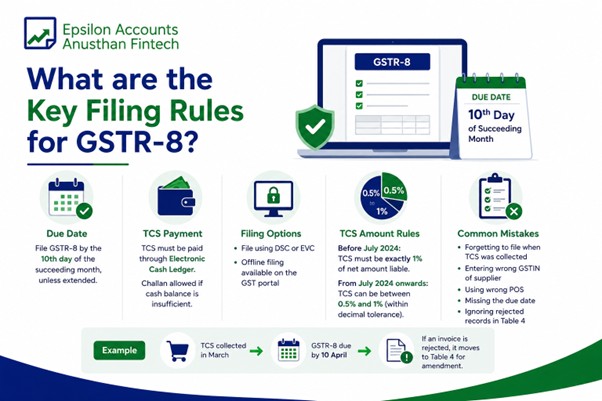
The biggest rule is timing. GSTR-8 must be filed by the 10th day of the succeeding month, unless the government extends the date by notification.
TCS liability must be paid through the Electronic Cash Ledger. The portal allows payment by challan if the cash balance is not enough.
The filing can be done using DSC or EVC. The GST portal also supports offline filing. That helps larger teams prepare returns before upload.
For tax periods before July 2024, the total TCS amount had to be exactly 1% of the net amount liable for TCS. From July 2024 onwards, the portal allows a range between 0.5% and 1%, within decimal tolerance.
Common mistakes to avoid
- Forgetting to file when TCS was collected
- Entering the wrong GSTIN of the supplier
- Using the wrong POS
- Missing the due date
- Ignoring rejected records in Table 4
A practical example helps. If an e-commerce operator collects TCS in March, the return must be filed by 10 April. If one invoice is rejected, that record can move into Table 4 for amendment.
How do amendments work in GSTR-8?
Amendments are handled in Table 4. The GST portal says there is no cap on how many times details can be amended there. But the conditions for amendment are strict.
| Amendment situation | What happens |
| Supplier has not accepted the record | Operator can amend it in Table 4 |
| Supplier rejects the record | The rejected entry appears in Table 4 |
| Supplier has already accepted the details | No further amendment is allowed |
The portal also says the original tax period, financial year, and original supplier GSTIN cannot be edited while amending a record. That means accuracy in the first filing is important.
Here is the best practice: review Table 3 before filing, then use Table 4 only for genuine corrections. That saves time and avoids blocked edits later.
How can a CA company in Thane help with GST returns filing services in Thane?
A local tax firm helps when your return cycle is busy, your platform has many sellers, or your reconciliation needs attention. Epsilon Accounts Anusthan Fintech LLP presents itself as a top CA firm in Thane and Mumbai with GST, taxation, accounts, and finance experience.
It also offers GST consulting and compliance services, GST retainership, income tax filing services, accounting services, and TDS support. That makes it useful for businesses that need one place for multiple filings.
| Filing option | Best for | Typical benefit |
| In-house filing | Small, simple operations | Lower outsourcing cost |
| GST consultant support | Growing e-commerce businesses | Fewer filing errors |
| Full retainership | Regular compliance-heavy firms | Better monitoring and reminders |
For businesses in Thane, Wagle Estate, and nearby Mumbai zones, local support is useful because GST issues often need quick review, not delayed email loops. Epsilon’s office is in Wagle Estate, Thane 400604.
What should you check before filing GSTR-8 every month?
Before filing, confirm five things: TCS collected, correct GSTINs, correct POS, matching sales records, and any rejected entries in Table 4. Those checks reduce mismatch risk.
A clean process usually looks like this:
- Reconcile e-commerce sales with seller-wise records
- Check TCS amounts against the portal rules
- Review rejected entries and amendments
- Preview the draft return
- File with DSC or EVC before the due date
If your business also handles income tax and bookkeeping, a combined gst and income tax consultant can make monthly compliance much smoother. That is especially helpful for fast-growing e-commerce and marketplace businesses.
People also ask
Who is required to file GSTR-8?
Every registered e-commerce operator who must collect TCS on supplies made through its platform has to file GSTR-8. It is not a seller return.
What is the due date for GSTR-8?
The due date is the 10th day of the succeeding month. The government can extend it by notification.
Can GSTR-8 be filed if there is no TCS?
If there is no TCS liability and no auto-populated rejected record in Table 4, filing is not mandatory for that period.
Can GSTR-8 be revised later?
Yes. Amendments are handled in Table 4. But once the supplier accepts the details, further amendment is not allowed.
Conclusion
GSTR-8 is a monthly compliance return for e-commerce operators. It is simple in structure, but strict in timing and data accuracy. The main points are eligibility, the 10th-day deadline, correct use of Tables 3, 4, and 5, and careful amendment handling.
For businesses that want support in Thane, Epsilon Accounts Anusthan Fintech LLP offers GST returns filing services in Thane, plus accounting and income tax support under one roof. That makes it a practical choice for ongoing compliance.
Talk to Expert.