
A small business in India should keep its bills and books for at least six years, and closer to eight to be safe. GST law asks you to keep records for 72 months from the due date of the annual return, and income tax rules ask most professionals to keep books for six years from the end of the assessment year. So the short answer to how long accounting records should be kept is: longer than you think, and longer if any case or notice is open.
Most shop owners throw out old bills when the godown gets crowded. That’s understandable. A carton of faded thermal receipts doesn’t feel valuable.
But those papers are your only defence if a notice lands three or four years later asking you to explain a purchase, a credit claim or a cash deposit. This guide covers how long each type of record has to stay, how to store it without filling a room, and what you can safely throw away.
What does the law actually say about keeping records?
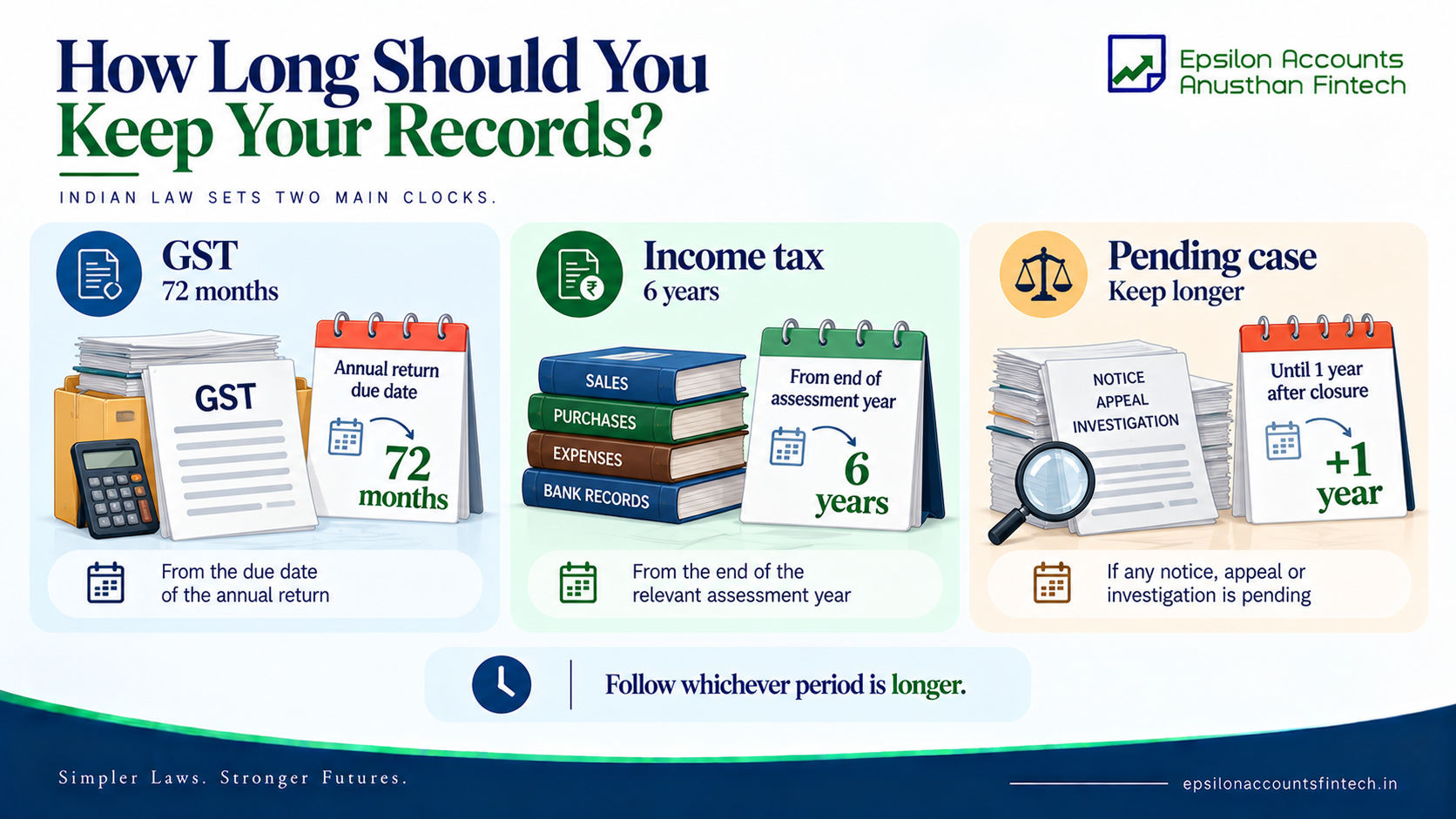
Indian law sets two main clocks: one under GST and one under income tax. GST records must be kept for 72 months from the due date of the annual return for that year. Income tax rules ask professionals to keep books for six years from the end of the relevant assessment year. Whichever clock runs longer is the one you follow.
The GST clock
Under Section 36 of the CGST Act, every registered business has to preserve its accounts for 72 months from the due date of the annual return for that year. So what this means is that bills from FY 2025-26, where the annual return falls due on 31 December 2026, have to be kept until 31 December 2032. That’s almost seven years from the last bill in the file.
The income tax clock
For professionals such as doctors, lawyers and architects, Rule 6F asks for books to be kept for six years from the end of the relevant assessment year. Businesses generally follow the same practice, because reassessment notices can reach back several years, and in serious cases even further.
The case clock
You might not be aware, but if any appeal, notice or investigation is pending for a year, the GST rule stretches further. You keep those records until one year after the case is finally closed, even if the 72 months have already run out.
Which records do you need to keep, and for how long?
You need to keep every record that supports a number in your returns: sales and purchase bills, bank statements, cash book, stock records, salary records and tax challans. The table below gives a practical retention period for each, set to the longer of the two legal clocks.
| Record | Why you keep it | Practical retention |
| Sales invoices and bills of supply | Proves turnover in GST and ITR | 8 years |
| Purchase bills and supplier invoices | Supports input credit and expenses | 8 years |
| Bank statements, all accounts | Matches turnover and payments | 8 years |
| Cash book and udhaar register | Shows cash movement | 8 years |
| Stock records and year-end count | Backs up profit and closing stock | 8 years |
| Salary register, PF and ESI challans | Labour and payroll compliance | 8 years |
| GST, TDS and income tax challans and returns | Proof of payment and filing | 8 years, or longer if a case is open |
| Asset bills (machines, fridge, vehicle) | Supports depreciation and sale | As long as you own it, plus 8 years |
Why eight and not six?
Eight years gives you a buffer over both clocks. It’s simpler to follow one rule for the whole shop than to work out a different date for every type of paper.
What happens if you can’t produce an old bill?
If you can’t produce a bill when asked, the expense or credit it supports can be disallowed. That means you pay tax on it again, plus interest, and sometimes a penalty. The bill itself might be worth ₹500. The tax on a disallowed claim can be many times that.
Input credit you lose
Under GST, credit is allowed only if you hold a valid invoice. If an officer asks for the purchase bill behind a credit claim from four years ago and you don’t have it, that credit can be reversed with interest.
Cash deposits you can’t explain
The income tax department can see large cash deposits in your bank. If you deposited your shop’s weekly cash in 2022 and get asked about it in 2026, your cash book and sales bills are what explain it. Without them, it can be treated as unexplained income.
If you’ve already thrown out records from the last few years, don’t panic. Start keeping them properly from today, and get someone to check what’s still recoverable from your bank and the GST portal.
How should a small shop store records without filling a room?
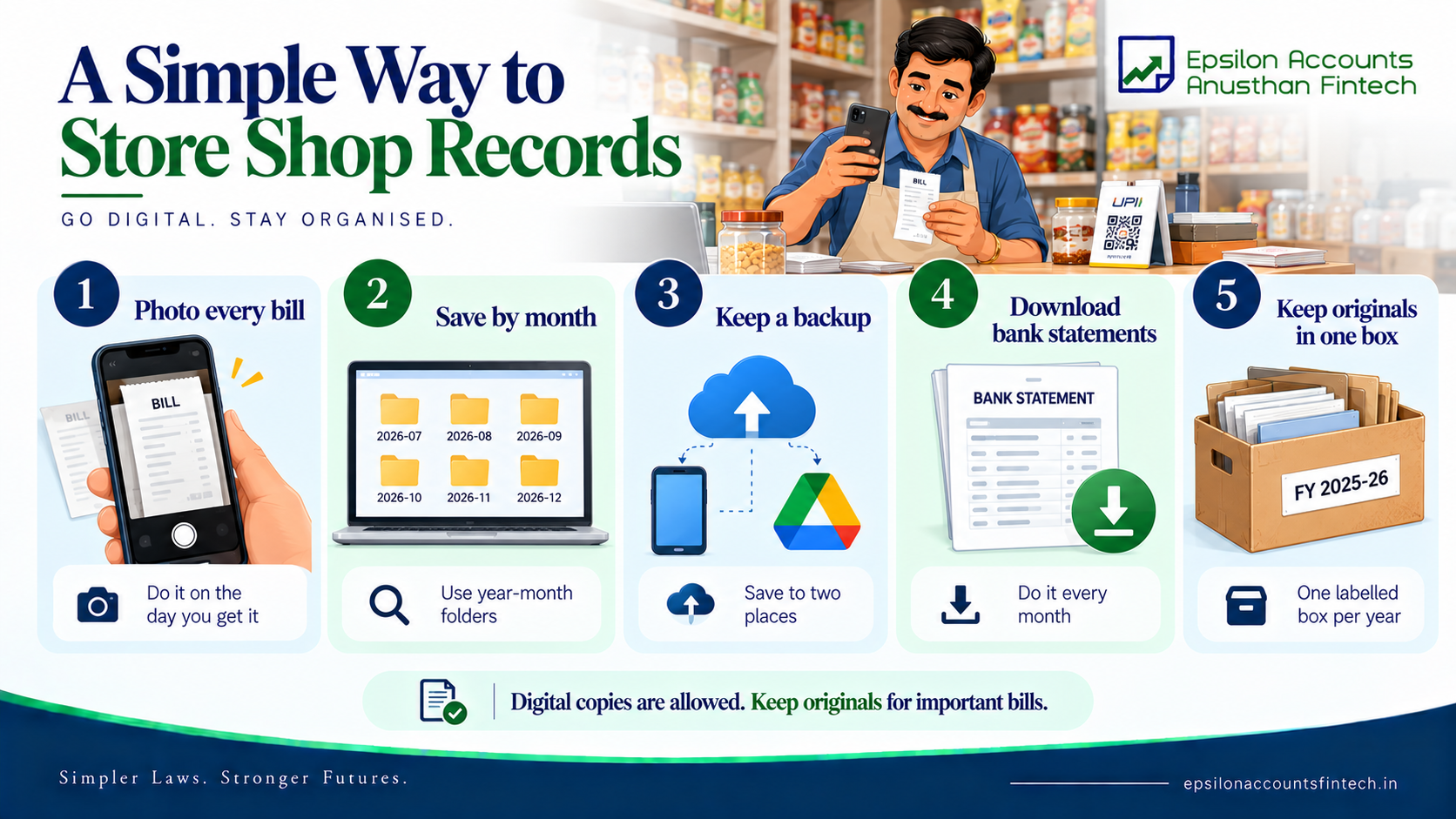
The easiest way is to go digital for everything you can and keep a small, labelled box for the rest. Scan or photograph every bill the day it comes in, save it in a folder by month, and keep the originals of anything important. Download bank statements every month instead of relying on the bank later.
A simple storage routine
- Photograph every bill on the day you get it: Thermal receipts fade within a year or two, so a photo is often the only readable copy you’ll have.
- Save files by year and month: A folder called “2026-10 purchases” is far easier to search than a phone gallery.
- Back up to two places: Your phone plus Google Drive, or a pen drive kept at home.
- Download bank statements monthly: Banks don’t always make older statements easy to get.
- Keep originals in one labelled box per year: Write the financial year on the outside in big letters.
Is a digital copy legally enough?
GST rules allow electronic records, provided they’re kept safely and can be produced when asked. Keep the originals of high-value bills, asset purchases and anything linked to an open case, just in case.
When is it safe to throw old records away?
It’s safe to throw records away once both the GST and income tax periods have passed for that year, and no case, appeal or notice is pending. In practice, that means papers older than eight years, with nothing open against them, can usually go. Shred anything with bank or Aadhaar details instead of tossing it.
A yearly clear-out check
- Check the year: Is it more than eight financial years old?
- Check for open cases: Any notice, appeal or pending refund for that year?
- Check assets: Is any bill tied to a machine or vehicle you still own?
If all three answers are clear, the box can go. Our team at Epsilon usually suggests doing this once a year, right after the annual GST returns are filed, so it never becomes a big job.
Frequently asked questions
How long should accounting records be kept in India?
At least six years under income tax practice, and 72 months from the annual return due date under GST. Keeping records for eight years covers both, and longer if any case or notice is still open.
Do I need to keep GST bills if I’m not registered?
Yes. Even unregistered businesses need purchase and sales records to prove turnover for income tax. Keep them for at least six years, since your ITR can be questioned well after filing.
Can I keep only scanned copies of my bills?
Mostly yes. Electronic records are accepted if they’re safe, readable and can be produced when asked. Keep originals of big purchases, asset bills and anything connected to an ongoing notice or appeal.
What if I’ve lost bills from previous years?
Start fresh from today and recover what you can. Bank statements, GST portal data and supplier copies can rebuild much of the trail. If a notice is already open, get professional help before replying.
Are thermal paper receipts valid as records?
They’re valid, but they fade within a year or two. Photograph or scan them the day you get them, because a blank receipt can’t support any claim when you need it.
Getting your records in order with a Thane accounting team
Epsilon Accounts Anusthan Fintech LLP helps small businesses across Thane and Mumbai set up record-keeping that holds up years later, from a monthly bill and bank routine to year-end reconciliations through its accounting services. The aim is simple: every number in your GST and income tax returns should have a bill or bank entry behind it, saved somewhere you can find it, so a future notice is a ten-minute reply instead of a lost month.
The best time to sort your records was five years ago. The second-best time is this month, before the next filing season. Talk to an expert and get a records checklist built around your business.