Summary
ITR forms are chosen by taxpayer type and income profile. ITR-1 suits many salaried residents with simple income. ITR-2 fits individuals and HUFs without business income. ITR-3 is for individuals and HUFs with business income. ITR-4 is for eligible presumptive-income taxpayers. ITR-5, ITR-6, and ITR-7 cover firms, companies, trusts, and similar entities.
Introduction
Income tax filing feels simple until the form choice begins. The wrong ITR can delay filing and create avoidable corrections. The Income Tax Department now lists seven return types for different taxpayer classes.
Many people in Thane face the same confusion. A salaried person, trader, company, or trust may need a different form. That is why CA firms in Thane and tax filing firms remain in demand.
This blog explains all seven ITR types in plain language. You will learn who should use each form, how to choose correctly, and when corporate tax filing services become important.
What are the 7 types of ITR?
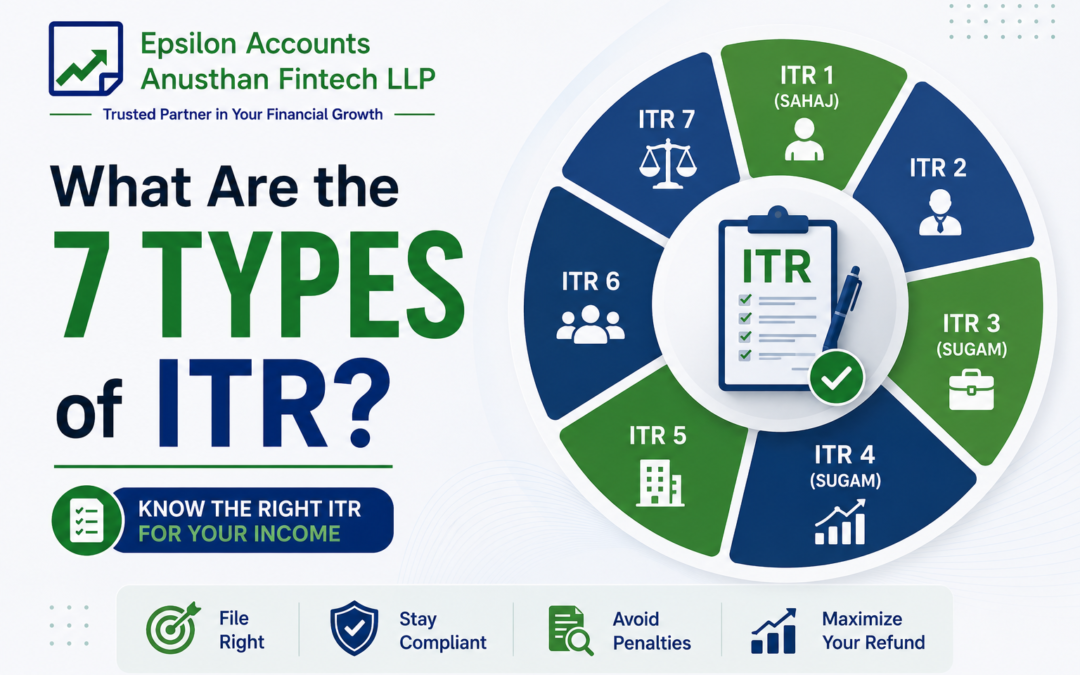
The seven types are ITR-1, ITR-2, ITR-3, ITR-4, ITR-5, ITR-6, and ITR-7. Each form is meant for a specific taxpayer category. The Income Tax Department says these forms are prescribed for different classes of taxpayers.
ITR-1 is for many resident individuals with salary, pension, one house property, and limited other income. ITR-2 is for individuals and HUFs without business or profession income. ITR-3 is for individuals and HUFs with business or profession income. ITR-4 is for eligible presumptive-income taxpayers.
ITR-5 is for firms, LLPs, AOPs, BOIs, cooperative societies, local authorities, business trusts, investment funds, and similar entities. ITR-6 is for companies other than those claiming exemption under section 11. ITR-7 is for persons, including companies, required to file under sections 139(4A) to 139(4D), such as trusts, political parties, institutions, and colleges.
Who should file each ITR form?
ITR-1 suits a resident individual with salary or pension income, one house property, and other sources within the allowed scope. It is not meant for many higher-complexity cases, such as directors or some unlisted equity holders.
ITR-2 is for an individual or HUF that does not have business or profession income. It is useful when income comes from salary, house property, capital gains, foreign income, or similar non-business heads.
ITR-3 is for individuals and HUFs with business or profession income. ITR-4 is for eligible resident individuals, HUFs, and firms using presumptive taxation, where income fits the permitted categories.
ITR-5 is for non-individual entities like firms, LLPs, AOPs, BOIs, societies, local authorities, and certain trusts and funds. ITR-6 is for companies that are not claiming section 11 exemption. ITR-7 is for specified entities such as charitable bodies, political parties, and institutions covered by the listed sections.
How do you choose the right ITR form?
Start with your taxpayer category. Then check the income heads. Finally, confirm whether business income or special exemptions apply. That sequence usually removes most confusion.
If you are salaried with simple income, ITR-1 may fit. If you have capital gains, foreign assets, or more complex reporting, ITR-2 may be safer. If you earn from business or profession, ITR-3 often becomes the relevant form.
If your income is covered under presumptive taxation, ITR-4 may work better. For firms, LLPs, and similar bodies, ITR-5 is usually the starting point. For companies and exempt institutions, ITR-6 or ITR-7 may apply.
A practical example helps. A freelance designer in Thane may need ITR-4 if eligible. A private limited company in Thane will usually look at ITR-6. A charitable trust in the same city may need ITR-7.
Why do CA firms in Thane help with ITR filing?
CA firms in Thane help match the right form to the right taxpayer. That matters because filing the wrong return can trigger revisions, delays, or extra compliance work later.
They also review income patterns more carefully. That is useful when you have salary plus freelance income, or business plus investment income. A good tax filing firm checks the details before submission.
Local support matters too. Thane taxpayers often need quick coordination for documents, notices, and clarifications. A nearby CA firm can handle filing with better context and faster follow-up.
For individuals, this means fewer errors. For businesses, it means cleaner records and better continuity year after year. That is especially valuable when income and compliance are linked closely.
When do corporate tax filing services become important?
Corporate tax filing services matter when a company must file correctly under its applicable ITR and supporting rules. The Income Tax Department states that companies file using ITR-6, except those claiming section 11 exemption.
These services become important when the company has payroll, vendor payments, GST records, loans, or multiple income streams. The filing must match books, approvals, and annual statements.
They also matter when the business has compliance changes during the year. A company in Thane, for example, may need smoother coordination between accounts, tax filing, and management reporting. That is where corporate tax filing services add value.
A tax filing firm can also help separate routine filing from risk areas. That includes regime choices, disclosure checks, and return consistency. The result is cleaner filing and fewer surprises.
What mistakes should you avoid while filing ITR?
The biggest mistake is choosing the wrong form. Many taxpayers pick a form based on simplicity, not eligibility. That often leads to corrections later.
Another common mistake is mixing business income with personal income. This happens often with freelancers, partners, and small business owners. The result can be wrong disclosure or wrong ITR selection.
People also ignore entity-specific rules. A company cannot file like an individual. A trust cannot file like a normal firm. The form must match the legal structure.
A final mistake is filing in a hurry. Tax filing should reflect the real financial picture. CA firms in Thane often fix exactly these issues before they become bigger problems.
What should taxpayers in Thane remember before filing?
Taxpayers in Thane should first identify their income type. Then they should confirm whether they are an individual, firm, company, trust, or other entity. That single step narrows the correct ITR form quickly.
They should also check whether business income is involved. If yes, the choice changes immediately for many taxpayers. That is why local tax filing firms often begin with a basic eligibility review.
For companies and organisations, corporate tax filing services are not optional planning tools. They are a practical way to keep compliance clean, especially when filings depend on accurate records across the year.
Frequently asked questions
What are the 7 types of ITR in India?
They are ITR-1, ITR-2, ITR-3, ITR-4, ITR-5, ITR-6, and ITR-7. Each one is meant for a different taxpayer category and income pattern.
Which ITR is for salaried individuals?
Many salaried residents use ITR-1 if their income fits the allowed conditions. If their case is more complex, ITR-2 may be needed instead.
Which ITR is for business income?
ITR-3 is for individuals and HUFs with business or profession income. ITR-4 may apply where presumptive taxation conditions are met.
Which ITR is used by companies?
Companies generally use ITR-6. Companies claiming exemption under section 11 fall under ITR-7 instead.
Why do people in Thane hire tax filing firms?
They want correct form selection, cleaner compliance, and local support. CA firms in Thane also help with business, company, and return-specific filing needs.
Conclusion
The seven ITR forms exist for a reason. They separate taxpayers by income type, legal status, and reporting need. Once you know your category, filing becomes much clearer.
For salaried people, businesses, trusts, and companies in Thane, the right support can save time and reduce mistakes. CA firms in Thane, tax filing firms, and corporate tax filing services can help you file with confidence.
Talk to Expert today and make your next ITR filing simpler, cleaner, and more accurate.