

By the Epsilon team | 11 min read
Section 54 and 54F capital gains exemption lets you reduce or wipe out tax on long-term capital gains by reinvesting in a residential house in India. Section 54 applies when you sell a house and reinvest the gain; Section 54F applies when you sell any other long-term asset, like land, shares or gold, and reinvest the full sale proceeds. Both are capped at Rs 10 crore and come with strict deadlines.
Key insights
- 54 reinvests the gain, 54F reinvests the proceeds: that one difference changes how much you need to put into the new house.
- The Rs 10 crore cap applies: since FY 2023-24, exemption under both sections can’t exceed Rs 10 crore.
- Deadlines are generous but unforgiving: buy within two years, build within three, or park the money in a Capital Gains Account before your return is due.
- Older property gives you a choice: for houses bought before 23 July 2024, you can pick 12.5% without indexation or 20% with it.
Do this before you sign the sale deed
Map out where the sale money will go and when. Most lost exemptions aren’t about eligibility; they’re about timing. A buyer’s cheque that sits in a savings account past your return due date can cost you lakhs.
Property sales in Mumbai and Thane often produce large gains on paper. A flat bought for Rs 40 lakh a decade ago can easily sell for Rs 1.5 crore or more today. Without planning, the tax bill on that gain can be a nasty surprise.
The good news is that the Income Tax Act has offered generous exemptions for reinvesting in a home for decades. The catch is that they come with conditions on what you sell, what you buy, how much you reinvest and exactly when.
This guide explains who qualifies for Sections 54 and 54F, how much you can exempt, how the 12.5% and 20% options work, the deadlines that matter, worked examples, and the common mistakes that cost sellers their exemption.
What is the difference between Section 54 and Section 54F?
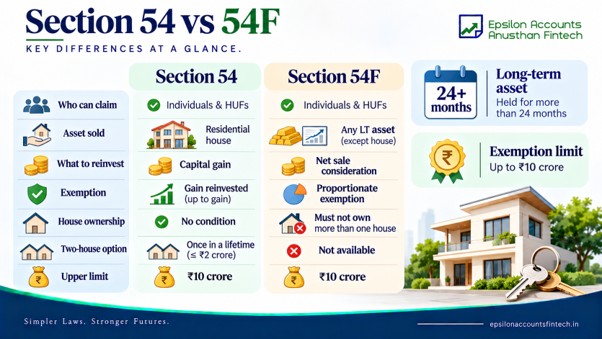
Section 54 applies when an individual or HUF sells a long-term residential house and buys or builds another residential house in India; the exemption equals the gain reinvested. Section 54F applies when you sell any long-term asset other than a house and reinvest the net sale consideration in a house; the exemption is proportionate to how much you reinvest.
Side-by-side comparison
| Feature | Section 54 | Section 54F |
| Who can claim | Individuals and HUFs | Individuals and HUFs |
| Asset sold | Long-term residential house | Any long-term asset except a house |
| What must be reinvested | The capital gain | The net sale consideration |
| Exemption | Gain reinvested, up to the gain | Proportionate to the share of proceeds reinvested |
| House ownership condition | None | Must not own more than one other house on the date of sale |
| Two-house option | Once in a lifetime if gain is up to Rs 2 crore | Not available |
| Upper limit | Rs 10 crore | Rs 10 crore |
When does a property count as long-term?
Land and buildings held for more than 24 months before sale are long-term capital assets. Sell earlier, and the gain is short-term and taxed at your slab rate, with no Section 54 or 54F benefit.
How much tax do you pay on property gains before exemption?
From 23 July 2024, long-term capital gains on property are taxed at 12.5% without indexation. For land or buildings bought before that date by individuals and HUFs, you can choose either 12.5% without indexation or 20% with indexation, whichever gives the lower tax. Surcharge and cess apply on top.
The two options
The Budget 2024 change cut the LTCG rate on property to 12.5% from 20%, and an amendment then restored the indexation option for property acquired before 23 July 2024.
Worked example: choosing the lower tax
A Thane flat bought in 2012-13 for Rs 40 lakh is sold in 2025-26 for Rs 1.6 crore.
| Option | Cost used | Gain | Tax rate | Tax before surcharge and cess |
| 12.5% without indexation | Rs 40 lakh | Rs 1.2 crore | 12.5% | Rs 15 lakh |
| 20% with indexation | Rs 75.2 lakh (indexed using CII 200 to 376) | Rs 84.8 lakh | 20% | Rs 16.96 lakh |
Here, 12.5% without indexation is cheaper. For property bought longer ago, or with smaller price growth, indexation often wins, so always run both.
How does the Section 54 exemption work?
Under Section 54, if you sell a long-term residential house and invest the capital gain in a new residential house in India within the time limits, the gain is exempt up to the amount reinvested, subject to the Rs 10 crore cap. If you reinvest less than the gain, the balance is taxable.
Worked example
Continuing the example above, the gain is Rs 1.2 crore.
| You reinvest in a new house | Exempt | Taxable gain |
| Rs 1.2 crore or more | Rs 1.2 crore | Nil |
| Rs 80 lakh | Rs 80 lakh | Rs 40 lakh |
| Rs 50 lakh | Rs 50 lakh | Rs 70 lakh |
The two-house option
If your long-term gain is up to Rs 2 crore, you can choose once in your lifetime to invest in two residential houses instead of one. Use it carefully, because you won’t get it again.
The Rs 10 crore cap
Budget 2023 capped the benefit, so deductions under Sections 54 and 54F can’t exceed Rs 10 crore, from FY 2023-24. This mainly affects luxury property sales in Mumbai, where gains above Rs 10 crore are no longer fully shelterable through a home purchase.
How does the Section 54F exemption work?
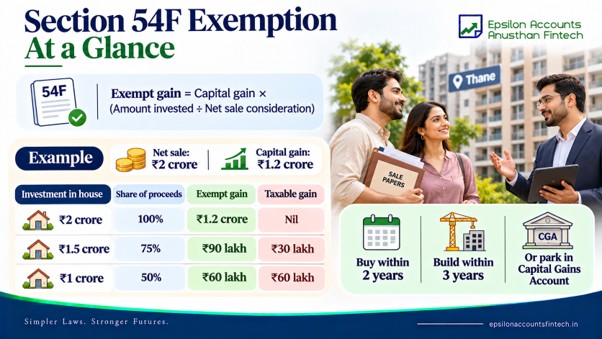
Under Section 54F, if you sell a long-term asset other than a house, such as land, a commercial shop, unlisted shares or gold, and invest the net sale consideration in a residential house, your exemption is the gain multiplied by the share of proceeds reinvested. Invest everything, and the full gain is exempt.
The formula
Exempt gain = capital gain × (amount invested in the new house ÷ net sale consideration)
Worked example
You sell a plot for a net Rs 2 crore, with a long-term gain of Rs 1.2 crore.
| You invest in a house | Share of proceeds | Exempt gain | Taxable gain |
| Rs 2 crore | 100% | Rs 1.2 crore | Nil |
| Rs 1.5 crore | 75% | Rs 90 lakh | Rs 30 lakh |
| Rs 1 crore | 50% | Rs 60 lakh | Rs 60 lakh |
The ownership condition
On the date of sale, you must not own more than one residential house other than the new one. You also mustn’t buy another house within two years or build one within three years of the sale, apart from the new house, or the exemption can be withdrawn.
What are the deadlines and lock-in rules?
To claim Section 54 or 54F, buy the new house within one year before or two years after the sale, or complete construction within three years. If you haven’t invested by your income tax return due date, deposit the unused amount in the Capital Gains Account Scheme. Don’t sell the new house within three years.
The deadline calendar
| Event | Time limit |
| Buy a new house | 1 year before to 2 years after the sale |
| Construct a new house | Within 3 years of the sale |
| Deposit unused money in a Capital Gains Account | Before your return due date for that year |
| Hold the new house | At least 3 years, or the exemption is reversed |
| Use the Capital Gains Account money | Within the 2 or 3 year window, or the unused part becomes taxable |
The Capital Gains Account Scheme
If you haven’t bought or built by your return due date, open a Capital Gains Account with an authorised bank and deposit the amount you plan to reinvest. You can then withdraw it for the purchase or construction within the time limit.
Managing the cash in between
This is where cashflow monitoring matters. Between the sale and the new purchase, large sums move through bank accounts, deposits and the Capital Gains Account. Good finance management services keep track of each rupee so nothing misses a deadline. Our business financial planning and management team helps sellers plan these cashflows.
What other options can reduce tax on a property sale?
Besides buying a house, you can invest up to Rs 50 lakh of long-term gains from land or buildings in specified bonds under Section 54EC within six months of the sale, with a five-year lock-in. You can also set off long-term capital losses and claim improvement costs and selling expenses.
Section 54EC bonds
| Feature | Detail |
| Who can use | Any taxpayer with long-term gains from land or buildings |
| Maximum investment | Rs 50 lakh in a financial year |
| Time limit | Within 6 months of the sale |
| Lock-in | 5 years |
Other deductions people miss
- Cost of improvement: documented renovation and extension costs.
- Transfer expenses: brokerage, legal fees and stamp duty paid by you.
- Capital losses: long-term losses from other assets can be set off.
Combining options
You can combine Section 54 or 54F with 54EC bonds for the same sale, as long as you don’t claim the same rupee twice. This helps when you don’t want to put the entire gain into a new house.
If you’re planning a sale in the next year, it’s worth running the numbers with your CA before you sign. A short planning session usually pays for itself many times over.
What mistakes cost sellers their exemption?
The most common mistakes are missing the Capital Gains Account deposit before the return due date, buying property outside India, owning too many houses for Section 54F, selling the new house within three years, and putting the new house only in a spouse’s or child’s name without checking eligibility.
Common mistakes
| Mistake | What happens |
| Missing the Capital Gains Account deposit | Exemption lost on the unused amount |
| Buying a house abroad | Not eligible; the new house must be in India |
| Owning more than one other house for 54F | No 54F exemption |
| Selling the new house within 3 years | Exemption reversed and taxed |
| Not keeping purchase and construction proof | Hard to defend the claim in scrutiny |
The new Income-tax Act
The Income-tax Act, 2025 came into force on 1 April 2026 with new section numbers. Sales before that date fall under the 1961 Act. For later sales, the reliefs carry forward under new numbering, and your CA will usually cite both while the transition settles. Check the important dates page for current filing deadlines.
Wrapping up
Sections 54 and 54F can turn a large property tax bill into a much smaller one, or none at all, if you plan ahead. Know which section applies, run both the 12.5% and 20% options, reinvest within the time limits, use the Capital Gains Account if needed, and hold the new house for three years. Most mistakes come from timing, not eligibility.
Epsilon Accounts Anusthan Fintech LLP helps property sellers in Thane and Mumbai plan capital gains, manage sale proceeds and file returns through its income tax filing services. To plan your sale before you sign, talk to our team and book a consultation.
FAQs
What is the difference between Section 54 and 54F?
Section 54 applies when you sell a residential house and reinvest the capital gain in a new house. Section 54F applies when you sell any other long-term asset and reinvest the net sale proceeds in a house, with proportionate exemption.
Is there a limit on Section 54 exemption?
Yes. Since FY 2023-24, the exemption under Sections 54 and 54F is capped at Rs 10 crore. Gains above that can’t be sheltered through a residential house purchase, though other options like 54EC bonds may help.
Can I claim Section 54 if I buy the new house before selling the old one?
Yes. Section 54 allows a purchase up to one year before the sale. Construction must be completed within three years after the sale. Keep purchase documents, payment proof and the sale deed for your records.
What is the Capital Gains Account Scheme?
It’s a special bank deposit where you park the amount you plan to reinvest if you haven’t bought or built a house by your return due date. You withdraw it later for the purchase or construction within the time limit.
What tax rate applies to property sold in 2025-26?
Long-term gains are taxed at 12.5% without indexation. For property bought before 23 July 2024 by individuals or HUFs, you can choose 20% with indexation instead, whichever gives lower tax. Surcharge and cess apply on top.
Can I sell the new house after claiming Section 54?
Not within three years. If you sell the new house within three years of buying or building it, the exemption is reversed and the earlier exempt gain becomes taxable in the year of the new sale.